“The "Chipalooza" Challenge. Open source analog IP for the SoCs of tomorrow. Five shuttle challenges across three major open-source PDKs. Design an #analog IP block, get it fabricated, and win awards for your effort.
“The goal of Chipalooza Challenge is to provide open source libraries of high-quality analog components useful to designers of SoCs for all three major open source PDKs, enabling cross-platform porting of SoCs and a shared home for the IP that analog designers need. Challenge #1, run by Efabless in 2024, produced dozens of analog circuits for Sky130 across two test chips. The five challenges below continue that work: two more rounds each for Sky130, GF180MCU, and #IHP SG13CMOS5L.”
Similar to #Tiny-Tapeout, I think? Challenge #2, on IHP SG13CMOS5L via IHP, has 28 designs and has schematic review complete. Challenge #3, on GF180MCU via Wafer.Space (#WaferSpace), was only launched on August 17th, but is at “proposal review complete”, so I guess the window to submit a proposal is pretty narrow! Challenge #4, on Sky130 via Chip Foundry, is “expected to launch” in November, and #5, another one on GF180MCU via Wafer.Space, is expected in January, and #6, another one on SG13CMOS5L, is expected in June. #hardware #electronics #PDK
on 02026-09-15Bob Widlar’s 01969 paper about superbeta transistors (β > 2000) with low Vce breakdown voltages for IC applications. #electronics #hardware #history
on 02026-09-04#MikesElectricStuff explains that Shenzhen Fine Mad (or Fine Made) Electronics (FM) has a “74HC595A” that can’t run nearly as fast as a normal 74HC595, lacks the enable pin, and has open-drain outputs. Unfortunately lots of anti-Chinese racism & xenophobia in the comments from “bd139”, “jonpaul”, “SL4P”, “floobydust”, and a particularly repugnant specimen from “CaptDon”. #electronics #hardware
on 02026-09-03#MikesElectricStuff recommends some fast-turnaround #PCBA companies in the #UK: <https://hcd-electronics.co.uk/> which he used to use and <https://www.fringeelectronics.co.uk/> (not fast), plus <https://www.ablcircuits.co.uk> (which he hasn't tried) and <https://www.pcbtrain.co.uk/> (“nearest thing UK has to JLC, but at much higher prices”). Also a discussion thread about how to qualify suppliers and reduce BOM delays. #electronics #hardware #manufacturing
on 02026-09-03#EEVBlog #video about PCB #manufacturing #toread. #electronics #hardware
on 02026-09-03#Usagi-Electric #video #toread discussing #JLCPCB #pricing having higher shipping costs now for #electronics #hardware #manufacturing
on 02026-09-03another Chinese #PCBA #electronics #hardware #manufacturing company, Longjiang Circuit.
on 02026-09-03a report from July that #JLCPCB and other #PCBA houses have raised their prices for 500-board runs 30% since “a couple of months ago” (≈April), presumably due to the #Iran war. #electronics #hardware #manufacturing
on 02026-09-03#Video by #Eurocircuits about #manufacturing 4-layer PCBs. They do PCB manufacturing, specialized in small prototype runs, but I don’t think they do PCBA like Aisler, JLC, or PCBWay. They do “order pooling” like JLC: they put multiple customers’ designs into a single panel. #toread #electronics #hardware
on 02026-09-03People on the EEVblog forum in 02021 reported that, although #JLCPCB supports a MOQ of 5 boards for #PCBA, some of the parts they can assemble with it have a higher MOQ. “For that particular part, the minimum quantity is 15. You must pay for 15, even if they only need 5 or 10 to assemble your boards.” There’s also an “attrition” amount for some parts, which is the number of parts they lose off the tape when they cut it (and you pay for). #electronics #hardware #manufacturing
on 02026-09-03The #Pineapple-One’s instruction memory board design, unfortunately in EAGLE. #electronics #hardware #RISC-V
on 02026-09-03overview of the #PULP #RISC-V #hardware family, with PULPino, PULPissimo, etc.
on 02026-09-03#Video from #Tr3bol Argentina about how in #electronics you often see badly-designed off-the-shelf step-up and step-down dc-dc converter modules built around LM2596 or XL4015 #hardware for buck converters, or the 1.2MHz ML3608 (which she doesn’t recommend using) for boost converters, and how you ought to really just build your own to make sure it works. She says they’re noisy (though I notice she didn’t bother to specify the volts per division on her oscilloscope still photo, but later she said it was 140mV ripple, while her own design got the ripple down to 60mV) and that you can accidentally set the voltage wrong, or vibrate or heat your potentiometer to the wrong voltage (in the schematic she shows, it isn’t ratiometric, so you have temperature drift). Also, humidity. Also, often, she says the commercial module PCBs are badly laid out, creating EMI problems and not respecting safety standards, use counterfeit chips, and are inadequately heatsinked. Most of the video is just still photos with lots of talking-head filler.
on 02026-09-03The #PULP architecture family from #ETH Zurich augments #RISC-V with #hardware zero-overhead loops and post-increment addressing. #ISA
on 02026-09-02#Tutorial #video by #Excessive-Overkill about field-oriented #control (#FOC), promising “from the ground up.” #electronics #hardware #toread
on 02026-08-25#EEVblog #video about jellybean #op-amps #electronics #hardware #toread
on 02026-08-20Says that type K #thermocouples (#sensors #hardware for use with #electronics), the common kind of thermocouples, work from a couple degrees above absolute zero up to 1260°C, with ±2.2°C or ±0.75% error, whichever is greater. Gives a data table for their output voltages, running from -6.458mV at -270° to 0 at 0° (by convention) to 29.129mV at 700° to 54.886mV at 1372°, which presumably is where they melt, which is about 40μV/°C, with predictable variations from linearity on the order of 3%. #metrology
on 02026-08-19LCD voltage test screwdriver #hardware
on 02026-08-11metal oxide semiconductor (#MOX) gas #sensors #electronics #hardware #tutorial
on 02026-08-11#video #toread about Gunn diodes #electronics #hardware
on 02026-08-07#video #toread about Esaki diodes #electronics #hardware
on 02026-08-07#video #toread about how magnetrons work. The dude has also made videos about Esaki and Gunn diodes. #electronics #hardware #radio
on 02026-08-07Home page for pcb (#PCB-program) which is no longer actively developed, but was an alternative to KiCad and EAGLE for designing #PCBs for #electronics #hardware.
#EAGLE #manual #PDF for designing #PCBs for #electronics #hardware.
on 02026-08-06#Blondihacks re-explains her approach to etching #PCBs for #electronics #hardware more recently (02012 instead of 02011). She recommends using pre-sensitized PCBs from Jameco.
on 02026-08-06#Blondihacks explains her approach to etching #PCBs for #electronics #hardware with Stephen Hobley’s recipe with vinegar and peroxide. #tutorial #bootstrapping #scouting
on 02026-08-06Stephen Hobley’s recipe for etching #PCBs for #electronics #hardware with 3% H₂O₂, 5%-acidity white vinegar from Meijer, and some salt; this might form peracetic acid #materials. #bootstrapping
on 02026-08-06#ebook of a dissertation on some experiments on diodes, showing that in 01959 Fairchild had silicon diode manufacturing sort of working. #electronics #hardware #history
on 02026-06-26RCA’s transistor and diode catalog from 01957. #electronics #hardware #history #ebook
on 02026-06-26this guy built an #ECL flip-flop on some copper-clad board with some 2N3904s (well, MMBT3904s). It only hit 40MHz; I wonder why he didn’t use like some 2SC3356es or something? #electronics #hardware
on 02026-06-25#video #toread about #CH32V003 #microcontrollers. #electronics #hardware
on 02026-06-22#GateMate #FPGA #electronics #hardware #PDF #datasheet
on 02026-06-22Hannah Ravensloft’s #PDF schematics of the #GateMate #FPGA #hardware design. #electronics
on 02026-06-22new #LiDAR #electronics #hardware sensor
on 02026-06-22"GateMate", a new (well, since 02020) #FPGA that supports #Yosys etc., made in 28nm at GlobalFoundries Dresden. They’re using 2-LUTs but have a 2×2-bit multiplier in each 8-input logic block. #hardware #electronics
on 02026-06-22#video on Anisha Patel’s #TENS #neurostimulation #electronics #hardware for muscle stimulation. No explanation.
on 02026-06-14#video on the "ElectroHelix" #TENS #neurostimulation #electronics #hardware for play parties from e-stim.co.uk. It uses 2mm pin connectors on the ends for medical sticky-pad electrodes. Their knobs (“level”, “feel”, “speed”) are not calibrated at all. 84000 views! #sex
on 02026-06-14Dmitry Grinberg designed an SBC with an #STM32 (STM32G030) that can run Linux at an interactively usable speed with just three 8-pin chips: the μC, an SPI PSRAM, and a USB-to-serial chip. Also some resistors and caps. #hardware #electronics #microcontrollers
on 02026-06-12#Tom-Jennings on why the TIP120 is obsolete #electronics #hardware and more generally on how you should use newer parts and not a 2N2222 or LM386
on 02026-06-07#paper #toread about snubber #electronics #hardware design for PWM inverters
on 02026-06-04#n2’s #opamp oscillator shootout. #electronics #hardware
on 02026-06-03#CNLohr has new #CH32V006 porn on his channel, featuring its supposedly 1.7Msps ADC in a TDR use case. Apparently its DMA can schedule future I/Os, apparently even to memory-mapped I/O addresses, and you can control the timing of ADC samples to within a single 48MHz CPU clock cycle, although you can’t sample at 48Msps. The ADC is astonishingly clear, especially when he uses an external quartz crystal to get more precise sample times; the code works on the #CH32V003 ADC but has worse precision, but the ’006 has a problem lacking on the ’003 — a discontinuity in the count at multiples of 512 (large DNL?). Oh and apparently UIAPduino SBCs powered by a CH32V006 are available for ¥290 in Tokyo vending machines? Which also sell Raspberry Pi Pico 2s for ¥1060‽ And, holy shit, he can actually very clearly visualize the reflections back and forth from a roll of coax cable with the opposite end open-circuited. He plots it with debug printfs and his "dyngraph" program. #video #microcontrollers #electronics #hardware
on 02026-06-02“With a 40 megohm resistor the sensor will start to respond 12-24 inches away (dependent on the foil size). Common resistor sizes usually end at 10 megohm so you may have to solder four 10 megohm resistors end to end.” #electronics #touch #Arduino #hardware #sensors
on 02026-05-30“z386: An Open-Source 80386 Built Around Original Microcode” #retrocomputing #hardware
on 02026-05-30#CHM #PDF of oral #history #interview with Napoleone Cavlan and Ronald Cline about the #Signetics field programmable logic family. #electronics #hardware #toread
on 02026-05-27#Signetics brought out the 82S100 (later PLS100) programmable logic array in 01975. Decapped die photos. #electronics #hardware #history
on 02026-05-27#PDF of the #datasheet for #Signetics’s 82S100 and 82S101 fuse-programmable logic array. Looks like a PLD: and/or/invert matrix with 16 inputs, 48 product terms, and 8 outputs. This version of the dadashit is from 01987 with parts from 01990, but I think the chip is from the 01970s. #electronics #hardware #history
on 02026-05-27actually #Signetics also brought out an unrelated microprocessor in 01975. #history #retrocomputing #electronics #hardware
on 02026-05-27#Signetics brought out a microprocessor in 01976. #history #retrocomputing #electronics #hardware
on 02026-05-27Semikey looks like another #hardware distributor similar to Digi-Key or LCSC, in #China (country code +86)
on 02026-05-26#PDF scan of the #paper on the design of the 20-bit bit-serial “MP944” CPU from 01971, part of the #CADC, which sure doesn’t sound like a microprocessor to me, despite the domain name.
The multiplier (“PMU”) was a 28-pin DIP, the divider (“PDU”) was another 28-pin DIP, the “special logic [functional] unit” was another 28-pin DIP, and the “steering unit” (of which there were three, one for each of the previous three modules) was another 28-pin DIP, and there were 19 vertical-microcode ROM chips: “Each functional unit is controlled by its own micro-instruction ROM.” To me it sounds like there were at most three CPUs, each consisting of a steering unit and either a multiplier, a divider, or a “special logic unit”, and maybe just one CPU split across 25 chips; when the paper uses the term “CPU”, it seems to be referring to all of these functional units together and perhaps the ROMs as well, not just one of them.
Moreover, the multiplier and divider just blindly did a multiply and, respectively, a divide, every “frame”. Only the “special logic function” could do “Conditional, and Unconditional data branching”. And all three “functional units” were controlled by some control bits from the “system executive control”, a group of ROM chips.
The “steering unit” was a “three channel serial digital data multiplexer” with three outputs which could add or subtract data under the control of part of the instruction word on its way to the PMU, PDU, or SLF.
It seems like the program counter, or rather counters, were located in the microcode ROM chips, which could increment them or reset or reload them under the control of some control lines. #hardware #architecture #history
on 02026-05-26#Chuck-Moore and C.H. Ting advocating the #MuP21 in somewhat unjustifiable ways in 01995. #architecture #stack-machines #hardware
on 02026-05-26#video on #speech-synthesis from an 8-pin #CH32V003, driving a speaker through a transistor, using 2-bit ADPCM and the Talkie #LPC speech synthesis library. #electronics #microcontrollers #hardware
on 02026-05-24#video on using LEDs as light sensors with the #CH32V003 opamp for visible-light over-the-air updates for his badge. #electronics #hardware #communications
on 02026-05-24#EEVblog #video on #CH32V003 #microcontrollers, documenting his half-hour to get the thing up and running, in January 02023, when it only cost 10¢. #electronics #hardware
on 02026-05-24#M5Stack are selling a US$75 ereader-sized (4 “inch” diagonal, 400×600) #eink #hardware kit with six colors, built around the #ESP32. #pricing
on 02026-05-23#M5stack #Cardputer Zero #hardware is going on sale for an “early bird” price of US$59. Raspberry Pi Compute Module 0 (BCM2837, quad-core 1GHz #ARM Cortex-A53, 512MB LPDDR2 RAM, 46-key shitty keyboard, 1.9-inch ST7789v3 LCD screen, 1500mAh LiPo, Wi-Fi, Bluetooth #BLE) in credit-card 85×54mm form factor, but much thicker than a credit card
on 02026-05-22#PDF datasheet for IRF IRLB3034 MOSFET #electronics #hardware
on 02026-05-17#Dmitry Grinberg reverse-engineered the Fisher-Price Pixter and found that its game cartridges were full of code for a Forth-like 16-bit stack machine. Apparently the Pixter Color he started with was an ARM, but the Pixter Classic was a 6502, probably from the Chinese 6502 vendor Sunplus/Generalplus. “Fair, there are some old cores commonly used today in cheap places, like the i-wish-it-would-already-die-but-it-will-outlive-me shitshow that is the 8051, but this is the first I’ve seen of a modern tapeout of a 6502.” This writeup also has a good explanation of how resistive touchscreen #hardware works. #microcontrollers #electronics #reverse-engineering #archival
on 02026-05-14#PDF #datasheet for TI’s obsolete 7404 TTL inverter #hardware. #electronics #history
on 02026-05-11Bonnie Baker explains how to get op-amp #electronics #hardware to produce a much wider output voltage range than normal by “bootstrapping” their power rails with a couple of MOSFETs.
on 02026-05-10#SPICE model of #LM324 #opamp #hardware. #electronics
on 02026-05-01using gSchem from #gEDA and the #PCB-program to design PCBs in 01999, with photos. #electronics #hardware
on 02026-05-01notes from two years ago on #self-hosting #AI on #Moore-Threads #hardware. Didn’t look good.
on 02026-04-29the #Moore-Threads GPU used by that gaming build. “MTT S80 gaming graphics card comes fully equipped with the advanced ChunXiao chip and houses 4096 MUSA stream processors. Operating at a core frequency of 1.8GHz, it's capable of delivering 14.4 TFLOPS of single-precision floating-point compute power.” #hardware
on 02026-04-29an amd64 gaming PC built from all parts from companies from #China: a Zhaoxin CPU (deriving from VIA and thence from Cyrix) and a #Moore-Threads GPU. #hardware
on 02026-04-29#PDF #appnote from #TI on the quirks of the #LM324 #opamp #hardware. #electronics
on 02026-04-29#cpldcpu decapped CH32V203 #hardware and found a separate NOR flash die in the package with the #microcontrollers. #reverse-engineering #electronics #toread
on 02026-04-29#cpldcpu got 99.5% MNIST accuracy with variable quantization and depthwise separable convolution on a CH32V002, a newer, smaller #RISC-V #CH32V003 with multiplier #hardware. #microcontrollers #electronics #hardware #neural-networks #toread
on 02026-04-29#cpldcpu got 99.5% MNIST accuracy with variable quantization and depthwise separable convolution on a CH32V002, a newer, smaller #RISC-V #CH32V003 with multiplier #hardware. #microcontrollers #electronics #hardware #neural-networks #toread
on 02026-04-29By #cpldcpu. I don’t think I’ve ever seen such a deep dive into the #WS2812 addressable LED #electronics #hardware before. The key finding is that the Lite-On LTST-G563 doesn’t do any signal regeneration and will thus work very poorly in long strings.
on 02026-04-29Rob Baruch’s Project 54/74 was a #reverse-engineering project to analyze all the 7400 series (and 5400 series) ICs from die photos of decapped chips. Robert C. Baruch, according to his Gmail address. I wonder what happened? #history #electronics #hardware #Project-54-74
on 02026-04-27#USB cheat sheet, with signaling rates, connector pinouts, marketing names, etc. #electronics #hardware
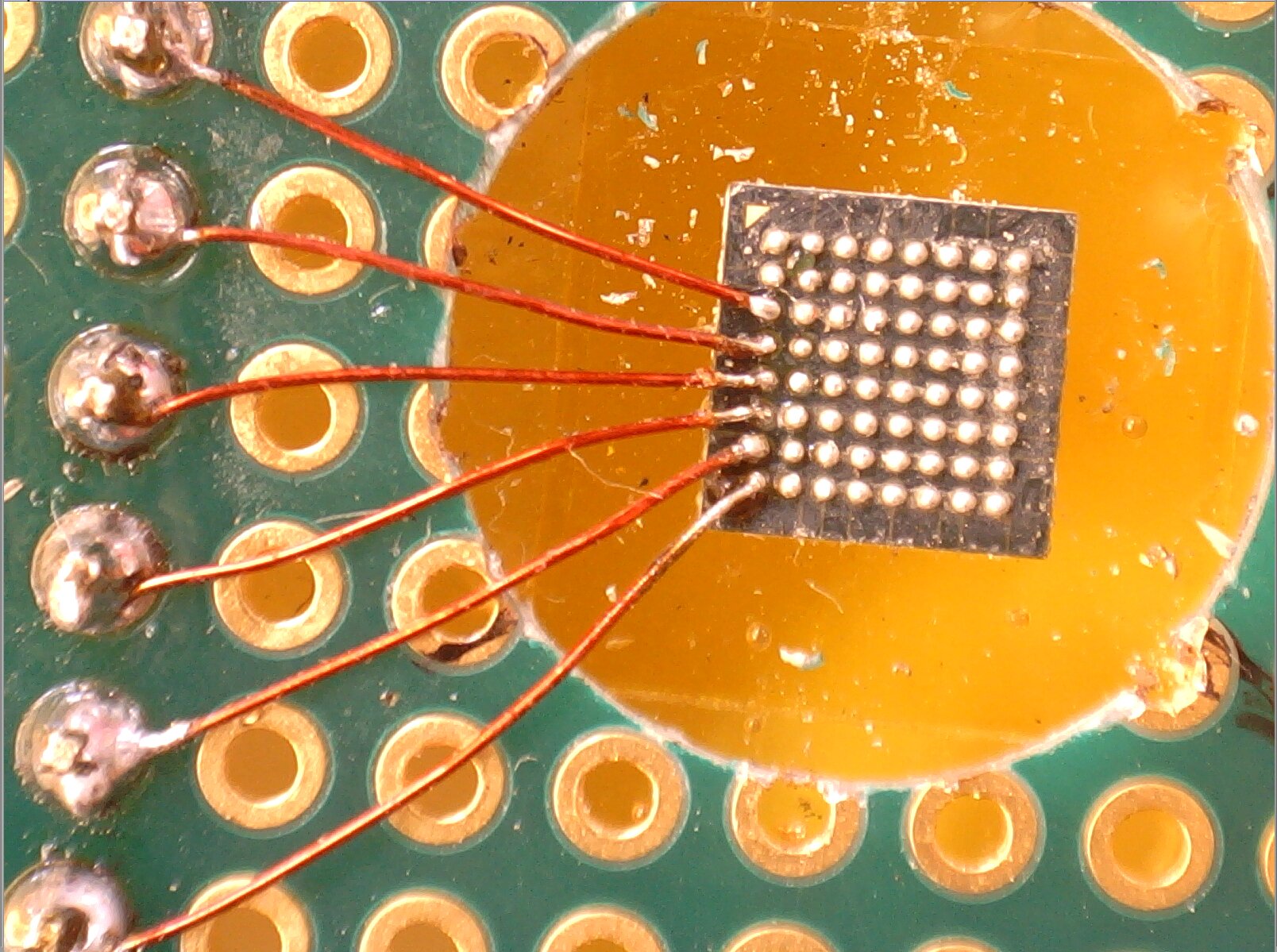
on 02026-04-25#image of #dead-bug technique with an STM32L053 BGA stuck to some perfboard. #soldering #electronics #hardware
on 02026-04-23brass, solder-plated turret pins to solder to or clip your test clips to: “In this picture four electrolytic capacitors use the pins as mounting posts. The leads will be wrapped around the posts and then soldered. This provides a superior mounting for the capacitors with minimal bending of the leads coming from the caps. The alternate method used these days is to bend the leads and stick them thru the PCB, #soldering to the copper tracks. This method is a source of problems as solder has no strength in itself and the caps are heavy, meaning that vibration from use or moving the equipment often creates hairline cracks in the solder joint resulting in electrical faults. (...) Once upon a time this method was very common in electronics equipment and will still be found in high end gear designed to last.” #electronics #hardware
on 02026-04-23Ferrite pot cores for #electronics #hardware.
on 02026-04-22#AvE #video disassembling an underpowered Ryobi drill which has a non-cartridge thrust bearing with loose bearing balls. #hardware #mechanisms
on 02026-04-21#PDF of #Epson real-time clock #electronics module RX8804CE #datasheet. 3.4ppm and 5.0ppm precision grades, with a “digitally temperature compensated crystal oscillator” (#DTCXO). #metrology #hardware. I²C. They’re like US$8 on Digi-Key.
on 02026-04-16IP65-rated card-sized (85 × 65 × 6.5mm, 32g) #Meshtastic #LoRa node #hardware for #RFID tracking with #GPS over kilometers, “SenseCAP Card Tracker T1000-E”. #Pricing of US$39.90. Rechargeable 700mAh battery. Uses “global ISM bands in the 863-928 MHz range”. #electronics #radio #communications
on 02026-04-16#video of Paul Lagier’s keyfob-sized #e-ink e-reader #hardware called “Pala One”, based on #ESP32.
on 02026-04-15new LCR #metrology #hardware with Kelvin clips for measuring parasitics on components for US$48: “FNIRSI® LCR-ST2 100K LCR ESR Meter 2-in-1 Digital Tweezers Bridge” #electronics
on 02026-04-13#Smoothieboard #hardware had showstopper supply-chain problems in late 02020 because of the #COVID shortages of #microcontrollers, which is how they ended up switching from LPCxxxx to #STM32. #history
on 02026-04-12#Mecrisp puppeting #MSP430 #microcontrollers over #JTAG to test your #Forth with access to peripherals without installing Forth on them, then cross-compiling and installing firmware on it that doesn't include the interactive Forth REPL. #hardware #electronics
on 02026-04-12#Mecrisp Stellaris #Forth apparently has pretty good support for #STM32 #microcontrollers #electronics #hardware
on 02026-04-12The Longan Pi is powered by the Allwinner H618 “(Quad-core ARM Cortex-A53 @ 1.5GHz, 64-bit)” with 4GiB, HDMI 4K, and GbE. #hardware
on 02026-04-10secondary emission can give #vacuum-tubes negative resistance, so Albert Hull designed an oscillator using them called the "dynatron" in 01918. #electronics #hardware #history
on 02026-04-10#Bunnie’s #dissertation #pdf on “a decentralized parallel computer” #toread #hardware
on 02026-04-09“An attempt to recreate the #RP2040 PIO in an #FPGA” gateware similar to the #RP2350 #electronics #hardware. Bunnie recommends using it to debug your PIO code with Verilator.
on 02026-04-09You can preorder Dabao #Baochip evaluation boards for US$10. #electronics #hardware
on 02026-04-09#Bunnie helped design “the Baochip-1x, a mostly open source 22nm SoC”, with an improved version of the #RP2350’s PIO peripheral. Instead of a special-purpose instruction set like PIO, you have BIO, four of Claire Xenia Wolf’s PicoRV32 #RISC-V processors each with 4KiB of RAM, running at 700MHz, modified with a trick from his PhD thesis ADAM to map the non-RV32E registers to FIFOs; also they can DMA to and from the main CPU’s RAM. But it’s slower than PIO, can’t bitbang DVI. #Baochip #electronics #hardware #toread
on 02026-04-09“It is a custom PCB designed to drop directly into the Z80 DIP-40 CPU socket of any legacy Z80-based computer. Rather than using a discrete #Z80 processor, the board hosts an RP2350B microcontroller — a dual-core 150MHz Cortex-M33 device capable of running at up to 300MHz — whose programmable I/O (PIO) state machines take full, cycle-accurate control of the Z80 address, data, and control buses.” Basically an ICE with Wi-Fi. #RP2350 #electronics #hardware #retrocomputing
on 02026-04-09#hardware #electronics explanation of “process corners”.
on 02026-04-09Tinycorp (#geohot’s #tinygrad company) is selling their own #AI #hardware, called the "Tinybox"
on 02026-04-08#PDF manual for 40-year-old 15.4-kilowatt motor control servo from Indramat using thyristor #electronics #hardware rather than, as we would today, IGBTs or power MOSFETs.
on 02026-03-19different sensing technologies that can be used in #keyboards, such as optical keyboards, hall-effect keyboards, tunnel magnetoresistance (TMR) keyboards, inductive keyboards, capacitive keyboards, and conventional “physical contact” switches. #hardware
on 02026-02-16#video on capacitor #electronics #hardware choice by #MrCarlson’s Lab #toread
on 02026-02-16half-hour #video #toread from 01959 from Bell Labs about memory #hardware
on 02026-02-16Hmm, Digi-Key’s cheapest op-amp #hardware #pricing is EVVO’s 1.547¢ LM2902 clone the LM2902DR-EV. Unimpressive 5mV input offset voltage though.
on 02026-01-16#JGC dissects disposable Fizzy Max III 60K Rechargeable Red Bull disposable vape #hardware and finds 800mAh LiPo #batteries, three microphones, and a microcontroller labeled “B0081S1” he wasn’t able to get into.
on 02026-01-14#video on making #precision #actuators from cheap stepper #motors instead of US$1 hobby servos to position an array of mirrors to paint light on a wall. Actually he just bought 40¢ stepper-based linear actuators off AliExpress, apparently leftover parts from obsolete cellphones, which turned out to move about 3.2μm per step; he reflow-soldered their flat-flex cables onto custom breakout boards with solder paste and a heat gun. Lacking closed-loop control, he homes the actuators by overdriving them in one direction plus about 200 steps, which stalls the motor but not for long enough to damage it. #hardware #electronics
on 02026-01-13middle school drama with #Sparkfun and #Adafruit means Adafruit is going to design new "Freensy" hardware as a #Teensy replacement based on #RP2350 #electronics #hardware
on 02026-01-09GPD MicroPC #hardware
on 02025-12-16#PDF of IBM #SAGE CRT #displays manual explaining how they cloned the #Charactron #hardware wih a 63-character stencil disk
on 02025-12-11#history of #Charactron #hardware
on 02025-12-11#video explaining that dipped ceramic disc caps with a black paint hat on the tip are NP0/C0G #precision caps. #electronics #hardware
on 02025-12-09“RAM prices have skyrocketed globally in 2025, with industry officials pointing to explosive demand from AI data centers as the primary cause. Mainstream DDR5 memory modules now cost at least twice what they did in mid-2025, and overall #DRAM contract prices were a stunning 171.8% higher in the third quarter of 2025 compared to a year prior.” #electronics #hardware #pricing #news #toread
on 02025-11-26Pauli Ratakorpi is taking die shots of #electronics #hardware
on 02025-11-11using #CH32V003 #microcontrollers for debugging connections to #ARM #electronics #hardware (alternative to ST-Link or J-Link) obtained by #hoarding disposable vapes. The protocol is CoreSight DAP (Debug Access Probe) over SWD, also implemented by CMSIS-DAP, DAPLink, or free-dap.
on 02025-11-11#video on #electronics #hardware for solid-state relays, such as the MOC3020–MOC3023 100mA triac-output optocoupler chips. #toread
on 02025-11-11#Thisismax #video on sensorless #FOC #control of #hardware #motors, using the most hilarious Nerf launcher I’ve ever seen, using three Kv = 2200 drone motors (minimum 10krpm) as rollers to launch the balls in a curved trajectory by controlling their spin. He wanted to use STMicroelectronics’s “#STM32 MC Motor Profiler”, but that would have required using Microsoft Windows, so he used the Arduino #SimpleFOC library instead. He gets motor position feedback from the back EMF of the motor windings (I’m not sure if this is inherent to “FOC”). He says most small drone motors are Y-topology. #electronics
on 02025-11-11The #Nintendo Ricoh 2A03 #electronics #hardware had a “delta modulation channel” for #audio sound effects using an up/down counter.
on 02025-11-11total unadjusted error in ADC #electronics #hardware
on 02025-11-11#Steve-Mould #video on a new kind of bone drill #hardware that avoids cutting skin and can literally cut the shell off a raw egg while leaving the membrane underneath intact.
on 02025-11-10#electronics #hardware #video putting a disc ceramic capacitor across a junction diode to reduce problems with reverse recovery time, specifically 60-cycle power supply noise in your audio amplifier
on 02025-11-10The #Commodore 64 SID #hardware’s sawtooth wave #signals weren’t very linear, more like an RC decay. #retrocomputing #video
on 02025-11-08#memory-LCD #displays #hardware being used in a bicycle computer: “The MIP display utilizes LTPS ( Low Temperature Poly Silicon ) technology to form memory circuits in each pixel. Each of these pixels is addressable, containing a 1-bit memory cell for storing information. (...) Because of this, TFT displays have power consumptions more than 40 times higher, requiring more electricity than a MIP display.”
on 02025-11-05#speech on #CH32V003 #microcontrollers #electronics #hardware using #Talkie
on 02025-11-05"Talkie" is an #LPC #speech library for #Arduino #electronics #hardware
on 02025-11-05state of embedded #Linux #electronics #hardware
on 02025-11-05Elektor on #pioasm #bitbanging 100-megabit #Ethernet #electronics #hardware on the RP2350
on 02025-11-05discussion of #pioasm #bitbanging 100-megabit #Ethernet #electronics #hardware on the RP2350
on 02025-11-05High-speed data acquisition over #HDMI #electronics #hardware #bootstrapping #DIY
on 02025-11-05#video #toread of “10¢” #electronics #hardware for making #music with #CH32V003 #microcontrollers
on 02025-10-21growing diamond on #electronics #hardware to spread heat more evenly. #toread
on 02025-10-21Currently cheapest #microcontrollers #pricing on LCSC: PMS150G-U06 (a SOT-23-6) for 2.02¢ in quantity 3000. #Padauk has broken the 3¢ barrier! One-time programmable. #electronics #hardware
on 02025-10-14#video #toread about voice coil #robotics #hardware #mechanisms from #Breaking-Taps. Inspired by birds. Using Dyneema cable actuation. Glass-filled PTFE bushings, carbon-fiber bones pressed into holes in fittings. He actually gave up on the rolling-contact cable-ligature joints and switched to conventional sleeve-bearing pin hinges. Using voice-coil actuators.
on 02025-10-14#video #toread about common-base amplifier design in #electronics #hardware for #RF #communications
on 02025-10-14microscope #video of Sharp #memory-LCD #low-power #LCD #displays #hardware
on 02025-10-13"Shineworld" may be the actual manufacturer of #Osptek and #good-display’s #LCD #displays. #electronics #hardware #low-power
on 02025-10-13other #low-power #Osptek #LCD #displays: “2.9 inch IPS SPI Interface 8 color TFT Display”, YDP290H003-V3, 210×480, 31×71mm, 2.8V, 14.3μA, but this one has 8 colors! #electronics #hardware
on 02025-10-13#Osptek (Osprey Technology of Taiwan, Yuying #LCD) is a different manufacturer of #low-power #electronics #displays #hardware; this one, model YDP420H003-V3, is 300×400 pixels, 64×85mm, 2.8V, 30μA. “4.2 inch IPS SPI Interface R/B/W Reflective TFT Display.”
on 02025-10-13#good-display #low-power #electronics #displays #hardware #pricing: US$6.89 for 384×168 and ≈80μW active-matrix monochrome reflective TFT from #good-display.com
on 02025-10-13320×240 95×75mm #memory-LCD for US$75.22. #low-power #displays #hardware #electronics #pricing
on 02025-10-13#memory-LCD #low-power #displays #hardware, with a very nice faceted database query thing: the left margin is an accordion with a section for each field and a checkbox for each value of that field, while the main display area has a card with name-value pairs for each selected record. Apparently they currently have an “LS044Q7DH01” that’s 4.4" (95×75mm), 320×240 (“QVGA”), 100μW hold power, 600μW 1Hz update power. It costs US$75 at Digi-Key! #electronics
on 02025-10-13#EEVblog forum about the μTimer project, where he is going to use #low-power #LCD #displays from #good-display #electronics #hardware
on 02025-10-13usage guidelines for #e-ink (“e-paper”) #electronics #hardware #displays: “• ePaper displays are suitable for update cycles ranging from tens of seconds to minutes. • Most black-and-white ePaper screens have a fast refresh rate of 1.5-2.5 seconds.” #good-display
on 02025-10-12#EEVblog #video about #low-power #LCD #displays (like 14.3μA at 3.3V, up to 25μA during updates, 2.9" diagonal and 384×168) and why he prefers them to #e-ink: e-ink takes tens or hundreds of milliamps for a second or two to update. And service life is only 5 years or 10 million switches. He’s going to try the nice high-resolution ST7305-based #good-display.com (Dalian Good Display Co., Ltd.) reflective active matrix TFT LCD, even though the MOQ is 1000, because they sent him a demo board. It’s a nice high-contrast black and white and a very wide viewing angle despite (I think?) not being #memory-LCD. @mikeselectricstuff says the ST7305 datasheet says it supports up to 30Mbps over SPI. @afreestone101 says that if you peel the polarizer layer off the memory LCDs, the black color becomes mirror shiny. #electronics #hardware
on 02025-10-12#PDF #documentation about the new 102.4Tbps #Broadcom #networking switch (2 page product brief, not a datasheet) #electronics #hardware
on 02025-10-09102.4 terabit per second (51.2 in, 51.2 out) 64-port optical (infrared) network switch with a “324B streaming frame size (SFS)” which I think means it can forward 16.7 billion frames per second #hardware #electronics #networking
on 02025-10-08#Bluepill #microcontrollers #electronics #hardware diagnostic guide for use with #Mecrisp #Forth.
on 02025-09-30Press release about Thierry Besson’s "Wildebeest" FPGA HDL synthesis tool for designing #electronics #hardware, released under an Apache 2.0 license. “Zero ASIC, a U.S. semiconductor startup on a mission to democratize silicon, today announced the release of WildebeestTM, the world’s highest performance FPGA synthesis tool.”
on 02025-09-29#AvE BOLTR #video about Milwaukee Fuel fencing stapler #hardware #mechanisms, including planetary gear sets, roller clutches, etc.
on 02025-09-25#bigclive #video explaining those little electromagnet-powered “perpetual motion” desk toys, showing the circuit consisting of a single npn transistor and the electromagnet, which is actually sort of an autotransformer. A high-resistance winding feeds some current from the emitter into the base, and then a low-resistance winding runs from the base to ground, while the collector is held at 6V. As he explains it, the approaching magnetic target starts switching the transistor into conduction, and then the transistor turns itself the rest of the way on? But then at some point the current stops rising, so the magnetic field stops rising, so the current into the base stops, and the transistor turns off, and the falling current snaps it even more thoroughly off. He reports that it still works if you add a flyback diode across the low-resistance winding, which is what you would normally want to do, but they don’t bother; I assume that drives the emitter-base junction into backwards (zener or avalanche) conduction during turnoff, and I don’t know what effect that has on the voltage. One of them has a duodecahedron I don’t recognize at its center, consisting of quadrilaterals that aren’t rhombuses; maybe it’s a distorted rhombic dodecahedron. #electronics #hardware
on 02025-09-18Cromemco used a 1-kilobit DRAM chip for their first digital camera sensor! #electronics #hardware #history #jugaad
on 02025-09-15#video explaining oscilloscope probe compensation for #electronics with the Laplace transform. #hardware
on 02025-09-03#video on #Jupyter #simulation of #electronics with #LTSpice. He’s using a library called spice_invoker and using some canned functions that invoke maybe matplotlib to plot the characteristics curves of various hypothetical transistors. #hardware
Digi-Key has 3402 of the SN74AUC2G53DCTR #74AUC2G53 analog switch IC in stock for 43.2¢. #electronics #pricing #hardware
on 02025-09-02#Polyimide #materials like Kapton as high-temperature capacitor dielectrics. #electronics #hardware
on 02025-09-02"CAM8" was #Norman-Margolus’s #cellular-automata #hardware from 01995. #electronics #history
on 02025-08-29scan of GE’s glow-lamp manual for neon lamps from 01966. #ebook #hardware #electronics #history
on 02025-08-24sodium-arc and mercury-arc lamps are also HID lamps. #hardware
on 02025-08-24My childhood book on digital logic (including a little #electronics) as an #ebook. #hardware
on 02025-08-24#electronics #video by #Pocket-Concepts of an ATtiny45-based 2%-error ammeter board with an OLED display, showing how he fixed all the mistakes he made in the design, and how the I²C OLED display works. #hardware
on 02025-08-09#bigclive #video dissecting NiMH and lithium AA cells; the NiMH one is mostly empty space in the middle! They’re largely punched metal mesh separated by electrolyte-soaked fibrous separator which looks a bit like thick paper, with lots of powdery paste smeared into the mesh (presumably largely depolarizer). The last battery, a Lidl NiMH cell, caught fire spontaneously as he was disassembling it, but not due to a short circuit; not only was it theoretically fully discharged, but the bits of mesh material that caught fire had no path to the other electrode. I guess it was a pyrophoric metal hydride cathode. Rapid deployment of the Explosion Containment Pie Dish prevents disaster. “There may be a delay between exposure to air and spontaneous combustion.” #hardware
on 02025-08-09#pinouts of #PS2 ports, parallel ports, etc., #electronics #hardware, but focused on #USB C PD
on 02025-07-30Oscar #Toledo explains that he’s using 74LS00 #TTL #electronics #hardware in his latest #Transputer board design instead of CMOS because his local electronics parts stores stock it
on 02025-07-20a 50¢ 16-line I²C GPIO expander chip #electronics #hardware
on 02025-07-20#video of AMD EPYC 9005 Turin Zen 5c #hardware with 384 cores per socket, 2 sockets, 24 DIMM slots
on 02025-07-09#news on TI #manufacturing #hardware in the US, planning they’re going to invest US$60 billion in obsolete (?) semiconductors manufacturing
on 02025-06-21PCBShopper lets you compare #pricing from 16 PCB houses on one page. #hardware #electronics #manufacturing
on 02025-06-21#Chronova hand #manufacturing an electric motor whose shaft is 90μm across, like William McLellan’s answer to Feynman’s “Lots of Room” challenge. It’s a permanent-magnet rotor nestled in between four straight electromagnets wound with 20μm wire. He kept losing parts. He spent several months on it. His soft iron rotors had coercivity that was too low, and #machining alnico on his lathe turned out to be impossible until he used grinding wheels. He finally gave up and just floated the alnico disc in watch oil on the other side of a cover slip. He got an electromicrograph. #small #motors #hardware
on 02025-06-17#Akio finally built a better #switched-reluctance motor, with laminated stator and rotor, which he got laser-cut from 60 layers of 1mm non-electrical steel for €200, 16 turns of ½mm² copper wire on each of his 12 stator poles. 2000 rpm, 400mA, with no load, 1–2A when stalled with his fingers on the shaft, no torque or power measurements given. #motors #hardware #bootstrapping #DIY
on 02025-06-17#video lecture #toread about #switched-reluctance #motors #hardware
on 02025-06-17#video #toread about #DIY building #switched-reluctance #motors #hardware
on 02025-06-17another #video #toread about #switched-reluctance #motors #hardware
on 02025-06-17#video #toread about magnetic field theory in #switched-reluctance #motors #hardware
on 02025-06-1735-minute lecture (so-called “webinar”) #video #toread about #switched-reluctance #motors design. #hardware
on 02025-06-17#video #toread about #switched-reluctance #motors #hardware, #SynRM demonstration
on 02025-06-17Hour-long #video #toread about #switched-reluctance (?) reluctance synchronous #motors. #hardware
on 02025-06-17Lecture #video #toread about #switched-reluctance (?) reluctance synchronous rotor design. #hardware #motors
on 02025-06-17Lecture #video #toread about #switched-reluctance (?) reluctance synchronous rotor theory. #hardware #motors
on 02025-06-17another #hardware #MPW shuttle program similar to CMP, MOSIS, etc. “MUSE SEMICONDUCTOR: It’s not just an MPW. A flexible MPW service to support research. Small minimum areas, frequent tapeouts, PDK and IP access, short cycle times.”
on 02025-06-13another #hardware #MPW shuttle program similar to CMP, MOSIS, etc., by UmbraLogic LLC.
on 02025-06-13FleaFPGA Experimenters Board. UPDATE 17/12/2016: This product has now been retired. By #Flea86? #FPGA #hardware
on 02025-06-12The TMS320C3x series is still active but it costs US$40. #hardware
on 02025-06-12#PDF #datasheet for Analog Devices ADR1001 ovenized LTZ1000 high-precision voltage reference #electronics #hardware. “The on-chip heater, combined with Analog Devices buried Zener technology, allows the ADR1001 to achieve sub-ppm temperature coefficient performance and single-digit ppm long-term drift performance.”
on 02025-05-2295¢ #8051 #microcontrollers with 800ksps 10-bit ADC (or 12-bit at 200ksps), plus two analog comparators, USB, 700pJ/insn, 8K flash, 2.3K SRAM, 13 5V-tolerant GPIOs. #electronics #hardware #pricing
on 02025-05-22#video by #NurdRage on the keychain-based radioisotope photovoltaic generator, extracting tritium vials from plastic keychains and using a Soxhlet extractor to remove the plastic encapsulation with dichloromethane, then removing the silicone from the ends with concentrated sulfuric acid. He put 14 of the glass vials side by side, totaling about 100mm with maybe 60mm length, sandwiching them between two amorphous silicon solar panels of that size with clear plastic tape. Open-circuit voltage 1.9 volts per panel, but only on the order of a microamp (per panel) short-circuit current. He put it in series with a 1MΩ current-sense resistor to measure the current more exactly, reduced to 893kΩ by the parallel impedance of his voltmeter, so he could measure the current accurately; short-circuit current was about 900nA, and the maximum power point was about 1.65 volts and 600nA, thus almost 1000nW, 1μW. With the second PV cell this increases to 1.23μW. The more sensitive circuit increased the measured open-circuit voltage to about 2.02V. Results with a monocrystalline cell peaked at 71nW at 70mV (when scaled up to the size of the amorphous panel) due to the cell’s poor suitability for low-light generation. #electronics #hardware #energy
on 02025-05-22a simulator for the GreenArrays F18A #Forth #hardware
on 02025-05-20#PDF slide deck about how Flash memory works. #electronics #hardware
on 02025-04-30#video on tips for hand-assembling surface-mount #electronics #hardware with a DIY vacuum pump, blu-tack, doublestick tape to keep component tape from moving around, polyester stencil for solder paste, etc.
on 02025-04-23#video on #laser diode wavelength stabilization by adjusting the drive current and temperature (using a resistive heating element!) to compensate for wavelength shifts. Demonstrates “mode hops” on an oscilloscope; the initial heating using a temperature sensor (a transistor I think) is to get it to a mode-hop-free region, and then the current is PID-controlled to stabilize the wavelength, and a second control loop adjusts the temperature to “desaturate” the current controller. He says he got the wavelength stabilized to ±2nm “over a range of 200mm”, which I think means 10⁻⁸, not 2/555 or so. #optics #toread #hardware
on 02025-04-12#hardware #simulation #video by Sebastian Lague extending a simple store-ALU-output-in-A-or-B computer to have 256 bytes of simulated RAM. Includes a nice #introduction to SRAM and DRAM etc.
on 02025-04-12#video by #Bugeja on getting piezo buzzers to provide useful haptic feedback by overvolting them to 200V with a TI DRV8662. #electronics #hardware
on 02025-03-26#video dead-bug soldering an SMD package (a relatively fine pitch LGA) on a prototyping area with superglue. #electronics #hardware
on 02025-03-26#video from #Wuerth on aluminum polymer capacitor #electronics #hardware. Suggests estimating the lifetime of an aluminum electrolytic as L_0 \cdot 2^{\frac{T_0 - T_x}{10°}} and an aluminum polymer capacitor as L_0 \cdot 10^{\frac{T_0 - T_x}{20°}}. So every 20° drop in temperature from the max operating temperature T_0 extends the lifetime of the aluminum electrolytic 4× and the aluminum-polymer cap 10×, though warning, “All ratings over 10 years are very much theoretically [theoretical].” Suggests aluminum polymer caps are worse for low-energy applications and battery-powered applications (because of higher leakage), and high-vibration applications, than electrolytics, but better for low-temperature applications (because of freezing) and DC-DC converters, as well as high temperatures.
on 02025-03-18#LCSC #pricing for 16-pin #CH32V003 #microcontrollers #electronics #hardware: 14.21¢ in quantity 500. Not the cheapest, but it’s a RISC-V with IIRC an on-board op-amp, though the linked datasheet only covers the CPU really.
on 02025-03-16#LCSC #pricing for 14-pin #PY32 #ARM #microcontrollers #hardware, 9.01¢ in quantity 500. Not the cheapest, but it’s an ARM. #electronics
on 02025-03-16#video of #Bitluni making a laser vector display with some laser galvos driven from an #ESP32, burning out a lot of hardware in the process. #microcontrollers #electronics #hardware
on 02025-03-04haha, #8051 #hardware from #WCH running at 56MHz with 6KiB of RAM.
on 02025-02-23The open-source #IHP #PDK middle of last year: “Designs already submitted for production include a delta-sigma modulator put together as part of Boris Murmann’s electronic engineering course at the University of Hawaiʻi at Mānoa, a 24GHz low-noise amplifier (LNA) from Martin Sander at Ulm University, a different LNA targeting cellular devices from a team at the Friedrich-Alexander-Universität Erlangen-Nürnberg (FAU), and a simple RISC-V CPU designed by Daniel Schultz and Steffen Reith.” #hardware #electronics
on 02025-02-23#IHP Tiny Tapeout. Mostly just digital #electronics #hardware designs.
on 02025-02-23full listing of #GF180 #PDK devices. MIM capacitors are “1.0fF/um²” up to twice that. #electronics #hardware
on 02025-02-23#IHP 130nm BiCMOS Open Source #PDK for analog, mixed-signal and RF design. Work in progress, but they’re doing their first #Tiny-Tapeout already. “SG13G2 is a high performance BiCMOS technology with a 0.13 μm CMOS process. It contains bipolar devices based on SiGe:C npn-HBT’s with up to 350 GHz transition frequency (fT) and 450 GHz oscillation frequency (fmax).” #electronics #hardware
on 02025-02-23discussion of #electronics #hardware dimensions of physical transistors. “Contacted poly pitch”, the distance from one transistor’s gate to the next, is maybe 51nm in a 5nm process, but the actual gate length is about 6nm.
on 02025-02-23#hardware #electronics transmission electron micrographs of Intel’s 6nm process, showing gate widths of 1.7nm to 5.5nm and gate lengths of 6–7nm. The micrographs are taken aligned with the lattice so you can count the atoms.
on 02025-02-23#video #toread by Pat Deegan on #electronics #hardware #analog #ASIC design with Tiny Tapeout. Demonstrates how to use xschem.
on 02025-02-16#video on a very ingenious discrete-only transistor curve tracer with 21 discrete components. #electronics #hardware
on 02025-02-10#Applied-Science had to replace the image sensor chip on his camera PCB many times in order to use an oil-immersion microscope objective backwards as an f/0.38 lens (f=4mm). #electronics #hardware #optics #video #bootstrapping #toread
on 02025-02-05512KiB Flash #hardware for #pricing of 3.63¢ in quantity 1000, 104MHz SPI. The Zetta ZD25LD40BTIGT.
on 02025-01-30#photo of General Atomics Energy Products 160μF 3kV pulse capacitor, containing no P.C.B.s. A metal box the size of two fists. #electronics #hardware
on 02025-01-24#video by #Hyperspace-Pirate of zesty bridgewires with 4kJ in a bank of five capacitors in series, with a calculated peak of 10kA, charged up with ZVS #electronics. He blew up his flyback diode and his SCR. Relatively poor slow motion footage. #hardware
on 02025-01-23#Mitxela’s FLIP-fluid simulation on a 100MHz STM32 microcontroller in a gold-plated charlieplexing pendant. #electronics #hardware #manufacturing
on 02025-01-16#electronics #hardware design for reverse voltage protection: P-MOSFET with input V+ on drain, 100kΩ to V- on gate, and 10V zener from gate to source. On initial connection, body diode biases zener to 10V with tens of microamps through the 100kΩ, pulling the gate low and turning the channel on, eliminating the body diode’s forward drop.
on 02025-01-15#GreatScott #video #toread on the #TL431 #electronics #hardware
on 02025-01-08another #openEMSstim #video on #TENS #neurostimulation, this one from Hasso Plattner Institute HCI. The off-the-shelf stimulator, a “TNS SM2 / MF” made by Pierenkemper GmbH, runs off a 9-volt battery and delivers 70mA on I guess each of two channels; three potentiometers offer control, including two supposedly calibrated in mA and one in Hz. He demos stimulating the palm flexor muscle; at 10mA his hand contracts. The electrodes are sticky and come on a plastic pad that permits reusing them without having to apply gel. #electronics #hardware
on 02024-12-20#video about "openEMSstim" #electronics #hardware for #TENS and similar #neurostimulation. Apparently it can communicate over #Bluetooth #BLE. At 6'20" he’s demonstrating controlling his arm from an Android phone.
on 02024-12-20patterns in register map design #hardware #toread recommended by #dnm
on 02024-12-19#video on #bootstrapping "Neurostimduino" #TENS and EMS neurostimulation unit with a 25mA current limit on each channel. One-minute ad. #electronics #hardware
on 02024-12-14Dennis Kuschel’s My4th Light #Forth #CPU #hardware
on 02024-12-10crackpot #Claudio-La-Rosa’s ternary-logic CPU prototype #hardware
on 02024-12-10discussion of crackpot "Claudio La Rosa"’s ("claudio_mos") ternary-logic CPU prototype #hardware
on 02024-12-10a 500V 8A MOSFET #hardware for US$1.1636 in quantity 50
on 02024-11-27"Afterburner" is a #PAL/#GAL programming #electronics #hardware design for #Arduino based on #GALBlast, including “experimental support for ATF1502AS and ATF1504AS”
on 02024-11-27"ATFBlast", #GALBlast derived #electronics #hardware design for #PAL and #GAL programming, supporting National GAL16V8; Lattice GAL16V8A, GAL16V8B, GAL16V8D; Lattice GAL22V10B; and Atmel ATF16V8BQL, ATF22V10B, and ATF22V10CQZ
on 02024-11-27#PAL #GAL programmer #electronics design "GALBlast" for programming “16V8/A/B/C/D/Z/ZD, 18V10/B, 20V8/A/B/Z, 20RA10/B, 20XV10/B, 22V10/B/C/Z, 26CV12/B, 6001/B and 6002B” but not “AMD PALC and PALCE, ICT PEEL or Atmel ATF chips” with parallel-port #hardware
on 02024-11-27the PMS150G #datasheet #PDF (the 2¢ variant of the #Padauk #microcontrollers) #electronics #hardware
on 02024-11-22obsolete #retrocomputing #electronics #hardware for #delay-lines; right now there’s an ADL-SE2246F combo filter/delay line (for PAL) for £3. But most of the alternatives are silicon chips.
on 02024-11-22#PDF dissertation from 01968 where Backers proposes “Ultrasonic #delay-lines for the PAL colour-television system” #history #electronics #hardware
on 02024-11-22air-based #delay-lines #hardware #electronics for memory
on 02024-11-22more about #delay-lines #hardware from TVs. #electronics
on 02024-11-22using #delay-lines #hardware from a PAL TV for 32 bits of memory #electronics
on 02024-11-22what "shift left" and "shift right" mean in the context of #DevOps and I guess the #hardware product design cycle #toread maybe #management
on 02024-11-20some FETs, especially SiC power JFETs, come in packages with an additional source lead for making “kelvin connections” for the gate drive. #electronics #hardware
on 02024-11-16#video #toread on many different #electronics #hardware #manufacturing prototyping techniques
on 02024-11-12#video on scratching off the surface of copper-clad FR4 PCB with a scriber in order to make a quick prototype board for surface-mount #electronics #hardware #manufacturing
on 02024-11-12#Marco-Reps #video #toread on #precision #metrology power supplies #electronics #hardware
on 02024-11-12#Marco-Reps #video on #precision #metrology for evaluating his open-source ADR1000 voltage standards. He ends up #3D-printing #flexures out of ASA for its low creep to preload copper-on-copper rotary-switch contacts to try to keep oxidation down. His stator contacts are bare copper on an aluminum PCB. #electronics #hardware
on 02024-11-12#video about LED #lighting lightbulb #electronics failure modes. A resistor came desoldered from the aluminum PCB on the first one. (I didn’t realize that some of them have current-limiting resistors shrinkwrapped into the leads from the E35 lamp base to the board, 10Ω in the case he shows.) In another case, a 200Ω surface-mount resistor had failed short. Interestingly he disassembles the lamp bases by running a boxcutter around under the metal base, breaking the bond to the insulator that separates the base electrode from the thread electrode. An older bulb with a cast-aluminum heatsink has a switchmode power supply in the base. Its power transistor and other major components were good, so he doesn’t find out what the problem was. #hardware
on 02024-10-30the Steinhart-Hart equation is a complicated equation for semiconductor resistance in #electronics #hardware
on 02024-10-28Apparently #Raspberry-Pi #RP2350 #microcontrollers have a bug where they draw about 100μA from their GPIOs in input mode when they’re close to ½Vcc, with some hysteresis. #hardware
on 02024-10-25Jeff Laughton’s KimKlone got a Bride of the Son of Cheap Video, following #Don-Lancaster’s Cheap Video Cookbook approach. #hardware #electronics
on 02024-10-24#Shirriff #reverse-engineering 7805 #electronics #hardware with die photos
on 02024-10-16#bigclive #video #toread on overcomplicated air freshener #electronics #hardware
on 02024-10-16#video on #3D-printing an #STM for #microscopy. This is a unimorph disc type made from a piezo buzzer; he ruined several before switching to ultra-fine magnet wires and low-temperature solder (ChipQuik?). His kinematic mount seems to consist of three bearing balls, one in a V-groove, one on a flat glass surface, and one in some kind of a pit, each adjustable with a knurled screw. He seems to have used heat-set inserts to build his frame out of 3-D printed plastic — although PLA has the best TCE of common plastics, he’s using PA-CF, carbon fiber reinforced nylon, which ought to be pretty stable in the X and Y dimensions, like wood. (He mentions that many STMs are made out of Zerodur or similar glass-ceramic #materials.) Printed on a Bambu Lab X1 Carbon. The voiceover might be an AI reading a script because it mispronounces a lot of words and sometimes gets the prosody of sentences wrong, despite having a bog-standard GA accent. He put metal tape on the parts for EMI shielding; looks like aluminum flashing. To pre-amplify the nanoamps or picoamps signal from the tunneling current, he copied Dan Berard’s open-source STM preamp circuit, naturally using a current-to-voltage converter built around an op-amp, but I can’t tell which one. He shielded his cable to the probe and put the analog electronics in a Faraday cage to reduce EMI further, getting only about 10pA of noise. Berard’s #electronics design used an OPA124, but he says “The chips used in Dan’s design are hard to find these days.” When it comes to #microcontrollers #hardware, he’s using a Teensy 4.1. He’s using an aluminum plate and some rare-earth magnets to damp the oscillations of his stable platform. “This is the first atomic image captured by a 3-D printed scanning tunneling microscope.”
on 02024-09-28"UniFlash" an opensource Unisoc/#Spreadtrum feature phone flash reader/writer. Cross-platform MediaTek feature phone dumping had been achieved long ago with MTreader. Now it’s time to do the same for Unisoc (ex-Spreadtrum) phones. And not only that, but also to be able to flash them and extract their compressed firmware contents!” #ghettobotics #electronics #hardware
on 02024-09-27#Spreadtrum firmware dumper for #ghettobotics. “1. Feature phones based on the SC6530/SC6531DA/SC6531E chipset. 2. So far, only a flash dump. Smartphones with Spreadtrum/Unisoc chipsets, but only tested on Tiger T310. You can read, write, erase partitions and repartition flash memory.” #electronics #hardware
on 02024-09-27#video of reusing #hoarding old earphones for #electronics #hardware. There’s a continuity-tester Android app, haha! Nice #jugaad with a 2.2kΩ resistor desoldered from a power-supply board, hot glue, and heat-shrink tape. And apparently there’s also a TV remote control Android app called ZaZaRemote by Tiqiaa if you plug infrared LEDs into your microphone port, which the app knows under the name “Smart-ZaZa” or “Audio-IR device”. #bootstrapping
on 02024-09-24#DIYPerks #video about things you can make from old laptops. Speakers (especially for laptops made around 02008). Heatpipes and cooling fan for cooling high-power LEDs. Diffusion sheets (for lampshades), fresnel lenses, and acrylic back panels (edge-lightable with LED filaments) from the screen. Or use them all together together with the existing backlight to get a lightbox or fake window. Non-smashed screens can be connected to an external driver board to make a monitor (they sell these?). Microphone (he recommends some prefab preamp board with AGC). Hard drive: disc sander for pencil sharpening (just by popping the cover off and gluing on sandpaper), wind chimes from platters, round mirror for analog clock face, laser galvo from the heads’ voice coil actuator (with a laser-pointer diode glued to it instead of using a mirror, you get an “analog VU meter” even with just one axis). 18650s from “older” battery packs (this video is from 02020, so maybe he means before 02010); he suggests sort of manually shapering your way through the plastic case, and using 2.8V as the lower limit for usable batteries, and apparently “single-cell battery-bank cases” are also a thing you can buy. Laptop webcams are usually USB! (Certainly true of this laptop here.) #hoarding #electronics #hardware
on 02024-09-23#Dr-Volt #video about converting an old Logitech mouse into a camera. It had a custom Logitech DIP on a single-sided PCB, separate from the ADNS 2610 camera sensor DIP, which has an 18×18 array of photodiodes visible under a microscope, with an “AGILENT 28D3D” label on the exposed die and a date of “2004”. Since he didn’t have a datasheet for the Logitech microcontroller, he hooked up the sensor chip to an #ESP32 S3 (programmed with #PlatformIO and VSCode) from his collection of #microcontrollers, like the one he’d built a laser scanning microscope from before. The chip uses an SPI-like protocol, but using a bidirectional data pin, and it exposes registers for not just Delta_X and Delta_Y but also some others including Pixel_Data, reads from which provide one pixel after another (so there’s no way to request a particular pixel). The mouse’s native resolution seems like a decent monochrome microscope, but with a very small field of view. He was able to get about a 3fps frame, unsurprising for what’s basically a debugging feature. He grafted the ESP32 into the mouse. #hoarding #electronics #hardware
#video about "SynRM" #switched-reluctance motors made out of sheets with slots punched out to follow field lines. Low-quality AI voiceover from #Lesics. #hardware
on 02024-09-22#video on very simple single-coil #switched-reluctance motor #hardware. Not optimized; a low efficiency mild steel design, science-fair style. Requires manual start!
on 02024-09-22#video by #Akio showing his Arduino-driven #switched-reluctance motor #electronics control board and working motor #hardware
on 02024-09-22"Lo-tech" 8-bit ISA (PC-XT) bus adaptor for IDE (ATAPI, PATA) hard disks “for vintage PCs”. #retrocomputing #hardware
on 02024-09-18#video on #Huawei’s new "Ascend 910C" GPU #hardware. Mostly repeating stock footage and Ken Burns Effect, not worth watching.
on 02024-09-11#video by #Cesar about #hoarding HP printer/scanner #electronics #hardware recovering an optical disc encoder labeled “200 LPI” (driven from a DC motor with a toothed belt), some buttons, an external power supply, optointerruptors, a carriage mechanism (with linear tape optical encoder), another motor with encoder from the scanner part, an RGB LED strip (running on 5V with a common anode), a solar fruit dehydrator,
on 02024-09-10#Cesar #video #toread about #hoarding CD and DVD drives. #electronics #hardware
on 02024-09-10#video about #hoarding old TVs, specifically a Samsung CW-28D83N CRT unit. He gets two speakers (8Ω 10W), a heatsink from the electron-gun driver, some resistors, electrolytic caps, ceramic caps, film caps, some zeners, etc. He thinks the yoke has “very interesting parts” because magnet wire is “very expensive” and it has a “good chunk of ferrite” and another one. He also likes recycling wires. He’s even excited about the steel wires between the springs that held the CRT in. Okay, the degaussing coil actually is pretty fine magnet wire, though I wouldn’t describe it as having “epthepthional” quality as he does. He also really likes the powerline RFI filter, which is on a separate single-layer board, and he power cable, and the flyback transformer. And the pushbuttons, and the infrared phototransistor, and the PTC overcurrent safety, and more film caps from the main board, an NTC probe, the bridge rectifier, some 7805-family regs, more resistors and electrolytics and inductors, and the big chopper transformer, and the hard-to-find big transistors for driving the deflection yoke. He keeps saying each diode is Zener, which makes me wonder if he just thinks all diodes are Zener diodes, except for a couple of Schottkys; I think he also maybe identified a couple of MOVs as ceramic caps, but maybe I’m just misidentifying ceramic caps as MOVs. He likes the TDA7297 audio amp chip and the heatsinks. Oh, toward the end he identifies an epoxy power rectifier as a diode without saying it’s a Zener, but then he misidentifies the glass signal diode next to it as a Zener, despite being contradicted by the silkscreen. This is kind of borderline; I don’t think this quite deserves a plonk for “electro jungla”, but it’s so not a high-quality video. #electronics #hardware
on 02024-09-10#Cesar #video about #hoarding #cellphones #electronics #hardware
on 02024-09-10#EEVBlog forum thread about #Padauk #microcontrollers #hardware #electronics
on 02024-09-07#Padauk #microcontrollers #hardware overclocked to drive WS2812s #electronics
on 02024-09-07#video #toread #OCW on power #electronics #hardware (43')
on 02024-09-05#ElectroBOOM #video #toread #formina on how to turn an LED on #electronics #hardware
on 02024-09-05#Electronoobs #video on #PID #control of a 220VAC heater with a triac #electronics #hardware
on 02024-09-05#video on the Sharp #memory-LCD I have; Andrej reports that it works fine at 10 megahertz even though it’s only specced for 2. That’s 100fps!! #electronics #hardware
on 02024-09-04#8051 #microcontrollers #datasheet #hardware #PDF
on 02024-09-01#PDF #ebook from 01988 by C.H. Ting, about the #Forth Novix #NC4000 #hardware design by Chuck Moore, a gate-array design from the 80s.
on 02024-08-31#video #toread on tiny Soviet pentode #electronics #hardware
on 02024-08-31#video #toread about reusing OTP EPROMs from the guy who explained how to reuse 8051s. #electronics #hardware
on 02024-08-31#video #toread about 8-bit #microcontrollers becoming obsolete, from the guy who explained how you can reuse 8051s. Or, rather, he claims that components can’t become obsolete. “Has anybody in their right mind ever said that 74-series logic is obsolete?” Yes, I think so, use a CPLD. Video quality is not good. #electronics #hardware
on 02024-08-31#video #toread on #Raspberry-Pi “diy fighting stick” #hardware #todelete
on 02024-08-28#video by #GreatScott from two years ago endorsing the #Raspberry-Pi RP2040 Pico #microcontrollers #hardware #electronics
on 02024-08-27a 240-megahertz Renesas RX72N with 4 mebibytes of Flash and a mebibyte of RAM for US$20.85 #microcontrollers #pricing #hardware #electronics
on 02024-08-27a 600-megahertz Cortex-M7 using external program memory and a mebibyte of ram for US$14.48 #microcontrollers #pricing #hardware #electronics
on 02024-08-27a dual-core 150-megahertz Cortex-M0+ with 2 mebibytes of Flash and a mebibyte of RAM for US$12.92 #microcontrollers #pricing #hardware #electronics
on 02024-08-27a 480-megahertz Cortex-M7 with 128 kibibytes of Flash and a mebibyte of RAM for us$11.27 #microcontrollers #pricing #hardware #electronics
on 02024-08-27#LCSC #pricing for #CH32V003 #electronics #hardware is 12.45¢ in quantity 500. These are #RISC-V #microcontrollers
on 02024-08-27Jean Hoerni’s patent notebook for the 2N709 transistor. #history #hardware #electronics
on 02024-08-25Fairchild’s gold-doped 2N709 transistor was designed specifically to enable the #CDC 6600 to achieve its 10MHz clock speed and therefore good #performance despite using RTL, by reducing saturation charge. The PMBT2369 or MMBT2369 is a current replacement that works slightly better. A six-stage ring counter on a PCB runs at 17.7MHz, which is a propagation delay of under 5ns, reducible to 3.5ns with a higher gate current of 10mA. #hardware #retrocomputing #electronics
on 02024-08-25#PDF of the AIM-559 #paper from 01980 on the "SCHEME-79" #Scheme chip #hardware by #GLS. Badly scanned
on 02024-08-25#PDF #paper AIM-514 from 01979 by #GLS, on #hardware designed to run #Scheme #Lisp
on 02024-08-25#OpenCores has a custom search engine page (“CSE”) on Google for searching for #hardware #gateware designs
on 02024-08-25The #M5Stack folks have a credit-card-sized computer with a QWERTY keyboard, a tiny 240×135 IPS color LCD screen, an Xtensa ESP32, a MicroSD card slot, an infrared interface, a microphone, Bluetooth, and a #HY2.0-4P connector for their sensors. 84 x 54 x 17mm. #electronics #hardware
on 02024-08-20#HY2.0-4P #connector mechanical drawing for #I²C #electronics #hardware
on 02024-08-20another #HY2.0-4P #connector thing for #I²C #electronics #hardware, this one a multiplexer to let you use six devices with the same ID. Sometimes called Grove apparently
on 02024-08-20apparently a common #connector for #I²C devices (or maybe an #M5Stack specific one?) is this JST #HY2.0-4P thing (“Grove”?): 2.0 millimeter spacing between 4 pins. #hardware #electronics
on 02024-08-20#Android #hardware with a QWERTY keyboard that fits in your pocket and can run Debian, the "Titan Pocket", for US$290
on 02024-08-20bitbanging #DVI video #signals on #RP2040 #microcontrollers #hardware
on 02024-08-16#video #toread about military ruggedized laptop #hardware
on 02024-08-13new cheapest #microcontrollers: Cypress CY8C4045FNI-DS400T, 1.5¢ in quantity 1000. It purports to be a 48MHz Cortex-M0 ARM with 32KiB of Flash and 4KiB of SRAM in a 1.6mm x 2mm package, 0.31-0.37 mm thick, with nine GPIO pins. I think that’s 4000 Dhrystone MIPS per dollar. #electronics #hardware #pricing
on 02024-08-01NY8A051 family of 1.8¢ #microcontrollers #electronics #hardware
on 02024-07-17#PDF #electronics #hardware #datasheet for NY8A051H 1.8¢ #microcontrollers.
on 02024-07-17marketing #video on #battery testing #electronics #hardware for battery manufacturers and electic vehicle manufacturers
on 02024-07-11Rdot Ynvisible #displays #hardware are advertised as 0.3μW/cm² plus 1mJ/cm² per update, and they claim that reflective LCDs use 6μW/cm²
on 02024-07-10supercapacitor #electronics #hardware: 10 year life, 2.7 volts, 10 farads, 10mmø × 31.5mm, US$1.26 in quantity 50
on 02024-06-29#electronics #hardware: some of those electrolytic capacitors without the safety-pressure-relief cuts aren’t actually electrolytic, they’re conductive polymer. Others are, though, they just use a conductive-polymer cathode and have more subtle pressure-relief cuts. They still degrade over time, though, because the polymer oxidizes and breaks down.
on 02024-06-26#video of Iran’s #Shahed 136 kamikaze drone servomotor. It uses an #STM32 with six power MOSFETs to control a brushless motor and read from an encoder; these motors sell for €20 in Ukraine. There’s a silicone conformal coating to protect the board. It uses a conventional 600μs–2.4ms PWM control signal. Interesting reverse-polarity protection circuit on the ground rail. Detailed schematic analysis, awesome. #electronics #hardware #microcontrollers #flying #weaponry #Le-labo-de-Michel
on 02024-06-26#video on #3D-printing for #manufacturing #electronics #hardware with the Micronics SLS nylon printer #toread #Krasnow
on 02024-06-25#video #toread on the best DIY method for #manufacturing printed circuit boards (PCBs) using UV-curing ink and solder mask. 3 hours. #electronics #hardware
on 02024-06-24current #neural-networks do not work for just spitting out working #electronics #hardware designs.
on 02024-06-24Jim Williams #appnote from 01991 on high-speed amplifier #electronics #hardware design
on 02024-06-18#Z80 single-board computer #hardware "Agon" (really eZ80) #retrocomputing
on 02024-06-16Zilog also still sells the #Z80 compatible EZ80F93AZ020EG #hardware for #pricing of only US$6.30 in quantity 10. Digi-Key has 159 of them in stock. This is only 20 MHz but has 64K of Flash built in, plus 4K of RAM.
on 02024-06-16Zilog still sells the #Z80 compatible EZ80L92AZ050SG #hardware for #pricing of US$16.76 in quantity 1, and Digi-Key has 2124 of them in stock. ROMless, 50 MHz, 24 I/O lines, 3.3 volts, 100-LQFP.
on 02024-06-16More about the end of #Z80 #hardware production. “While the Z80 was manufactured under license by many different companies at the time. SGS Thompson, Siemens, many of the Japanese semiconductor companies, etc. But I'm not aware of any still manufacturing it. Zilog may have been the last.” #retrocomputing
on 02024-06-16#video #electronics #hardware #history on the Zilog #Z80 which apparently just got canceled (but is still in stock at Digi-Key) #toread
on 02024-06-16#video #toread on #manufacturing a thermoacoustic Stirling engine #hardware
on 02024-06-15#video #toread on repairing ATX power supplies #electronics #hardware #hoarding
on 02024-06-15another #video on the #Octopus curve tracer. #electronics #hardware
on 02024-06-04#PDF #appnote on LV8548 dual H-bridge motor driver #hardware
on 02024-06-0440' #video by #Psychogenic-Technologies (Pat Deegan) on designing analog ASIC #electronics #hardware using Tiny Tapeout’s “new analog capabilities”. Basically he’s hacking together a SAR ADC with an 8-stage resistor ladder, although most of that process is omitted; he submitted it to Tiny Tapeout 6 as “WoWA”. I didn’t realize #Tiny-Tapeout had a WebGL GDS viewer. The video has an annoying amount of talking-head filler. He recommends using tinytapeout_analog_vm to get started quickly, and Efabless’s video, “Webinar - Analog schematic capture & simulation with Stefan Schippers”, who wrote #Xschem, which he’s using here, with the open SKY130 PDK. He remapped Magic’s and Xschem’s keys to match Kicad. He says both Kicad and Xschem do simulations in Ngspice. Xschem’s UI for exploring simulation results looks pretty interesting, being able to click on a waveform out of many waveforms on a plot to change which waveforms are displayed in other linked plots. He does a little bit of demo of using Magic, which evidently involves typing Tcl commands in a command window as you use the mouse, and he lays out a two-MOSFET mixer circuit in it, with guard rings and everything, after having designed and simulated it first in Xschem. He says Netgen (?) is a good LVS (layout vs. schematic) checker, even though its errors are hard to understand. He recommends simulating your digital blocks with Verilator.
#video #GreatScott on tiny power #electronics #hardware, building PCBs around a TI TPS63020 4-amp buck-boost converter, which takes 1.8–5.5V and provides 1.2–5.5V (programmed with a voltage divider) with 25μA of quiescent current, using a 2.4MHz switching frequency so it can use tiny external inductors and capacitors, with only 8 passives in all. So he builds the new PCB with 0805s (because he find 0604s hard to hand-solder). The dadashit has a very nice suggested layout. Despite worrying about hand-soldering, he paste-soldered the components with a stencil and reflowed them on a tiny 3-cm-square hotplate he evidently had, labeled MHP30. The 5V output was 5.115V (2.3% high, a big sloppy), while the 3.3V output was 3.393V (2.8% high). He got 2.8A out at 3.3V and 2.04A at 5V, with 71%–91% efficiency, the higher numbers being at lower loads. He did two more tighter layouts where he had to hand-solder some caps on the back after reflow; the current capability decreased to only 2.0A at 3.3V but the efficiency was the same. Comments suggest TPS631000 and TPS63900 as even lower-power alternatives.
on 02024-05-21CERN’s 8.5-digit DIY open-source voltmeter, now in the Open Hardware Repository. #electronics #hardware #precision #metrology
on 02024-05-21#Bitluni wrote an assembler and interpreter for a new CHIP-8-like bytecode in one day on stream. #video of his 10¢ CH32V003 240-LED matrix board. He wants to switch to a CH32X035, which sounds like it might not be #RISC-V, but has USB-C support built in. Previously he had the buttons on a resistor ladder. He has a tiny little postage-stamp-sized hotplate to reflow his QFNs. If you short D+ to Vcc at powerup time it goes into programming mode and you can install new firmware. #electronics #hardware
on 02024-05-19Za3k’s cardboard #Zorchpad #hardware #electronics prototype mockup
on 02024-05-17#video on #electronics #hardware of a synchronous dc-dc converter by #GreatScott. First, for comparison, he rigs up a simple buck converter, whose switch is an IRF5305 p-MOSFET with its gate pulled up to Vcc (12V?) by a 100Ω resistor or down to ground by a BC547 with a 220Ω base resistor; the freewheel diode is a rather large 1N5822 Schottky (½W?), and the output capacitor after the hand-wound 100μH inductor is a 330μF electrolytic. The BC547’s base is driven by a knockoff Arduino Teensy generating an 80kHz PWM signal. So he replaces the freewheel diode with an IRFB3077 p-MOSFET to cut the power losses from 40mW at 400mA to about 0.4mW. To ensure dead time and avoid shoot-through, he drives the MOSFETs with an IR2184 half-bridge MOSFET driver chip and nine passives it apparently requires for its gate-drive network for some reason. He got 92% efficiency in CCM.
on 02024-05-15#JLCPCB has new cheapest #microcontrollers: #Nyquest NY8A051H: 1.58¢ each in quantity 20000, or 3.2¢ in quantity 1 #hardware #pricing
on 02024-05-12#JLCPCB has the STM32G431 #hardware in stock for US$1.76 in quantity 30, less than half of Digi-Key’s #pricing
on 02024-05-12#hoarding #electronics #hardware #video #toread
on 02024-05-10Airwick fart neutralizer #electronics #hardware #video. He suspects it might be using a “tin oxide volatile organic compounds” sensor to see when to go off; a heating resistor heats a thin-film layer of doped tin oxide, and the “chosen” volatile organic compound lowers the resistance across the film. He wasn’t able to figure out much about it.
on 02024-05-10this SOP-8 #Puya PY32F002 #microcontroller #hardware has #pricing of 8.26¢ in quantity 500. A 24MHz Cortex-M0(+?)
on 02024-05-09OpenPuya project for #Puya #microcontroller #hardware. “In order to make up for the untimely update of materials on the official website, we will serve as an unofficial repository, collecting product materials from #Puran Semiconductor Company.” Mostly only in Chinese!
on 02024-05-09#video of #microcontroller #hardware, the #Puya PY32 Cortex-M0, with #pricing of 10¢ in quantity 500. Over ten minutes of worthless talking-head footage at the beginning of the video. 5.5 volts, reprogrammable. Part numbers sound like STM32F0 clones? PY32F0032A is 24MHz, 20KiB Flash, 3KiB SRAM, 18 GPIOs, 1 ADC, 3 timers, SPI, UART, I²C; the 30¢ PY32F030 has, among other things, 32KiB Flash, 8KiB RAM, and 48MHz; the 50¢ PY32F072 even has CAN and USB. You have to get them off LCSC. He’s using Keil and programming it with an ST-Link v2, and some people use Stm32Cube. Screenshots of py32.org, which still has Puran’s documentation for their chips. He’s only able to get the code to flash at 3.3V. He recommends reading the STM32 manual to learn how to set up the ADC, so I guess this really is an #STM32 clone. (He points at ST copyright notices in the BSD-licensed HAL source code.) He also recommends reading Puya’s example code in the zip file and the well-written PY32F030 series reference manual in English.
on 02024-05-09#video of #gomezgimenez #manufacturing a solder-paste stencil for #electronics #hardware from an aluminum can. The cotton gloves for handling the aluminum are a good idea. He anneals it with a clothes iron on the high setting on a corkboard for 20 minutes, then removes the paint with acetone. First he tries photolithography with photoresist film. For a photomask he prints out three identical transparencies on a Brother laser printer and cyanoacrylate-glues them together. His UV source for exposing the photosensitive film is one of those nail-salon UV caves. 2% washing soda removes the unexposed film. Then he etches the aluminum with a commercial etchant of HCl and sodium persulfate (‽). To remove the exposed photoresist film and the inner epoxy liner of the Coca-Cola can he uses acetone. This produces somewhat uneven and rounded holes. Second, he tries milling with a “CNC 1419” desktop milling machine, using a 100μm conical milling cutter with a 30° included angle. His workholding is supergluing painter’s tape on the back of the aluminum to painter’s tape on a plywood spoilboard. (Stackup: plywood, stickum, paint backing, superglue, paint backing, stickum, aluminum can, air.) The calculated kerf is 207μm from the sum of the 100μm tip, the 200μm surface penetration, and the 30° included angle. FlatCAM ingests the Gerber and runs the mill. His cutting fluid is 3-in-1 oil. This one seems to be cut more precisely, though not quite as precisely as PCBWay’s laser-cut stainless stencil.
on 02024-05-09#video by #gomezgimenez on #manufacturing a digital clock that works by illuminating falling sand at 10Hz, all initially controlled by an Arduino (maybe a Mega, not sure), though later he got his own board fabbed with an onboard micro, looks like a PIC18F4550 actually, then soldered the parts down with a solder-paste stencil and hotplate reflow. Demonstrates some interesting #manufacturing techniques, such as CNC-routing a PCB with a D-bit with auto-bed-leveling sensed by conduction to the (coppper-clad) workpiece. Standard captive-nut technique for screwing together FDM 3-D prints and PCBs. Not sure why each digit requires 4 pixel columns of sand instead of 3. Because he’s modulating the timing of the sand release with the (16!) solenoids rather than the timing of the light flashes, he doesn’t have to worry about leakage of light between columns. Unfortunately you’d need a higher refresh rate than 10Hz for this to be practical; a 10Hz flicker is maximally distracting. Also the sand runs out in two minutes. #electronics #hardware
on 02024-05-09#randomtronic Joule Thief build recycling a common-mode choke. #hoarding #electronics #hardware #toread
on 02024-05-09another #video, by #randomtronic, of the #electronics #hardware in a 1.5kV #flyswatter. From a distance it looks like the same design as the contemporary bigclive video, but he has the transformer’s primary winding on its collector as you’d expect — but with a series resistor, which you wouldn’t. And only 7.2MΩ of bleeder resistance, and a slightly different voltage multiplier design, which he describes as “confusing as hell”. He is also skeptical of the transistor pinout he got from the datasheet, so he plugged it into his TransistorTester and found that the terminals were backwards. But the primary of the transformer is still on the transistor’s emitter, as in bigclive’s analysis, rather than its collector. His understanding of how the Joule Thief works is the same as mine and different from the explanation given by bigclive in the previous video, with the current switched by transistor turning it off rather than further on.
on 02024-05-09older #bigclive #video on the #electronics #hardware in an electric #flyswatter, labeled as 1.5kV. It uses a (slightly weird) Cockcroft–Walton voltage multiplier on the transistor output, terminating in an 0.022μF kV cap with a 44MΩ bleeder, and has the primary side of the transformer on the (8050SS) transistor’s emitter (!) rather than its collector but otherwise a similar circuit to the later video.
on 02024-05-09#bigclive #video on the #electronics #hardware in an electric #flyswatter. The circuit is extremely simple! A transformer, a transistor (C2328A 30V 2A 1W), a 560Ω resistor, a diode, an 0.33μF 630V film storage capacitor, a 2.2MΩ bleeder resistor for it, and a probably unnecessary LED (with its own 560Ω resistor) and power button. It all runs off 3 volts from two AAs. It’s a blocking oscillator, basically a Joule Thief with a high-voltage secondary which is half-wave rectified into the storage cap; the resistor limits the current into the base of the transistor. Although I think I may have misunderstood how the Joule Thief works — he says the feedback winding turns the transistor on more until the core saturates, at which point it starts turning off. The two primary-side windings attached to the transistor are 1.5Ω each, and the high-voltage secondary is 150Ω. A commenter says his is 1500V, and he altered the output to 1μF 10MΩ for a “nice loud bang”.
on 02024-05-09#video #Cesar about #hoarding and recycling TVs and monitors. Magnet wire from the CRT yoke, 0.4mm diameter in one case; a ferrite core which works well as a microwave susceptor; a 40MΩ potentiometer; power transistors; the flyback transformer for high-voltage supplies; a 2-digit 7-segment LED display; an IR phototransistor; electrolytic capacitors; high-voltage ceramic capacitors; switches; clock crystals. He disassembles the CRT to show its parts; he suggests using the shadow mask as a fine mesh screen, and harvests the phosphor from the inside of the screen with a paintbrush, then dissolves the aluminum it’s mixed with using lye. #hardware #electronics
on 02024-05-08#video #hardware #electronics US$10 #calculators as of last year apparently run Android 9 (Pie) with multitouch screens? This “GHLBD” brand four-function calculator has a gigabyte of RAM, a 32-bit quad-core Allwinner A50 507 CPU (1512MHz Cortex-A7), 3+ gigs of Flash, and a 2700mAh LiPo battery. So this wild hacker installed bunch of #retrocomputing N64 #games in an emulator. Doom 3 runs at 16–32 fps.
on 02024-05-08#video about paperclip paddles for Morse code, hooked up to an iambic keyer; three jumbo paper clips, bent to shape with needlenose pliers, are screwed into a wooden block that the cable is stapled to. The nickel or chrome plating on the paper clips has kept them from oxidizing in storage. #electronics #hardware
on 02024-05-01DIY semiconductor photosensors from copper oxide #video #hardware #electronics
on 02024-04-29#video about improved #mechanical servomotors for hobby robotics. He’s using an SPI magnetic encoder with on-chip sensors to read the motor position, controlled with an #STM32 G0 interfaced via I²C, programmed in Rust, which controls an LV8548 H-bridge driver chip, which can handle 12V 2A output. #microcontrollers #electronics #hardware
on 02024-04-28#bigclive sex toy teardown, clitoral suction stimulator (“Nooky” brand from Poundland). It’s built around an unidentified 8-pin microcontroller and an outboard MOSFET (“A2SHB”) to PWM the motor, which pushes a rubber suction cup up and down with a crank. The microcontroller is powered at 3.6V with an E36F boost converter shunt controller running a diode, capacitor, and inductor, all of which are surface-mount, and then there’s an LC filter to low-pass filter the micro’s power. #mechanical #hardware
on 02024-04-14#EEVblog #hardware review of a US$25 multimeter, the Aneng AN8008, which is autoranging. He bought it on AliExpress. Same size as the Fluke 101. Has a falsified “1000V” voltage rating on the outside but only 250V fuses on the inside. He complains about the absence of safety measures like MOVs, though he does find a PTC resistor, and the terrible quality of the solder joints. But he really likes its large, high-contrast digits and “awesome” microvolt resolution, and verifies that it really is accurate to within about three parts in ten thousand, except for low ac voltages. It can measure capacitors too. It can generate a square wave at 50–5000Hz and also has a frequency counter, though it gives wrong answers above a few megahertz unless the signal is at least 150mV. Confusingly, the milliamps jack is the amps jack, not the volts and ohms jack. You can turn a backlight on. He says it’s missing the 10mA and 100mA ranges; if I understand right, if you want to measure over a milliamp you have to do it on a 1-amp range which only gives you milliamp precision.
on 02024-04-14#TPAI on boost converters #hardware #video with a demo of a manually-operated one. He mentions the TL494, which he “doesn’t recommend as a beginner’s project”, for which he recommends the LT1070, which he then builds a 20V laptop charger around. For his water-wheel power supply, he uses the “Delon circuit”, a full-wave rectifying voltage doubler with five components. Then he uses it to charge his cellphone and a gel cell from a stream. #electronics
on 02024-04-06AS5600 magnetic encoder example #hardware #video #toread
on 02024-04-06ozone generator build and testing #hardware #video #toread
on 02024-04-06#manufacturing a high-power #ozone generator #hardware #video using 3000 volts on each of several heatsunk plates to get corona discharge, plus a waterproof industrial fan to blow air through; he says the overall machine, with 3 modules totaling 12 plates, produces 120g/hour of ozone. The frame is welded up from steel structural tubing, with rivet nuts to add threads to the holes drilled in the tubing to which to screw the fan, ozone modules, frosted plexiglass side panels, aluminum top and bottom and fan panels, and air intake grille. The high-voltage wires have all the panels in parallel and are electrical-taped together, potted with household silicone inside a snap-together plastic conduit, zip-tied to the steel frame. He dremels holes in the side panels to epoxy-mount the electronic modules such as the timer, power meter, power entry module, and power switch. The modules’ screw terminals are potted in silicone presumably to prevent ozone damage. Uses about 350W. He doesn’t show the high-voltage power supply.
on 02024-04-06#bigclive inside an ozone room deodorizer #hardware #video #toread
on 02024-04-06#bigclive inside a nasty high-voltage ozone-generator power supply #hardware #video #toread
on 02024-04-06#bigclive high-power shady £16 #ozone generator teardown with schematic #electronics #hardware #video. Arrived with a broken ceramic plate through which it arced. Operates around 4000V and uses the “ridiculously high power” of 155 watts with a power factor of 94%. He says it really needs to be mounted in an enclosure with a fan so it doesn’t overheat. The wires to the high-voltage conductive-ink grids (very hard ink, harder than his box cutter) are silicone-insulated for high temperature, and the solder connections are silasticked over, presumably to prevent lower-voltage corona discharge. He explains that capacitive coupling through a high-dielectric-strength insulator gives you lots of tiny little sparks when you’d get an arc without the insulator. The input bridge rectifier is made out of 1N5399 1.5A 1kV diodes. An interesting oscillator design using a sort of totem pole of two npn transistors, perhaps FJP13009 (700V 12A; they’re labeled J13009-2), driven from (opposite-sense?) feedback windings on a high-current toroid, only used for feedback; its primary is in series with the primary of the resin-potted high-voltage transformer (2Ω primary, 100Ω secondary). Surprisingly to me, there’s a diac in the oscillator, which he says is the “start circuit”. The transistors are mounted on a giant aluminum heatsink through an insulating film (mica?). The primary of the toroid is tied to both rails of the power supply through rather large (0.47μF 400V) film caps, which discharge through the transistors when they come on. There’s no storage cap, so the oscillation dies down when the 50Hz signal is close to its zero-crossings. Originally I thought it was a blocking oscillator, but apparently the feedback through the toroid is positive, not negative; what terminates a pulse is when the film cap, discharging through the two transformers, runs out of charge, and thus stops turning on the transistor it was discharging through. “Normally, with transistors to a positive rail, you’d have a pnp transistor, but in this instance, because it effectively has its own transformer-coupled supply to its base here from the emitter, you can use standard npn transistors for both of them. (...) Much simpler circuitry than I was expecting.” The diac to the base of the negative-rail transistor is activated by a .01μF cap charged up through a 470kΩ resistor pulling it up toward the positive rail, though I’m not sure why you need the cap. The size of the heatsink makes me think it can’t be dissipating more than 5–10W, which means better than 92% efficiency.
on 02024-04-06#bigclive random high voltage eBay thing #hardware #video #toread
on 02024-04-06Arduino #hardware vs. Pico #video, but it seems to be talking-head filler mixed with stock images, and the guy ("Gary Explains") seems to be pretty fucking clueless: “Now the Arduino IDE provides a language, they call it the Arduino Language, which is based on the syntax of C and C++, and by syntax I mean, you need the semicolon at the end, where the equal sign goes is the same as in C, curly brackets, all that kind of thing.” Of course actually the Arduino IDE lightly preprocesses your sketch and compiles it with the G++ compiler for C++. #Plonk.
on 02024-04-0610 uses for a microwave oven transformer: #hardware #hoarding #video by #Murray-Smith. Among other things he demonstrates welding six of them together to get a large motor stator. #toread
on 02024-04-06#PlayWithJunk #video: most useful tool for #electronics #hardware repairs is a simple Huntron Tracker curve tracer or “VI curve tester”. Includes very simple schematic with a transformer and three resistors, labeled “#Octopus in-circuit component tester”, though it seems to me like it would not work very well and might actually blow up your scope if the circuit under test had a ground connection. He demonstrates using it to diagnose a blown PSU, desoldering components with an electric-air-pump solder sucker, something I’ve never seen before
on 02024-04-06#GreatScott cheapest Arduino alternative 20¢ #video #hardware He’s recommending the Holtek HT66F002, apparently unaware of the Padauk chips, even though he posted this only three weeks ago. It’s an 8-SOP with 1kB, an 8MHz internal oscillator, 6 GPIOs, a 12-bit ADC, and a 10-bit timer, but no I²C. He needs I²C, PWM output, GPIOs, an ADC, and low-power sleep. He ended up installing some proprietary Holtek IDE and buying a Holtek programmer, ugh, and then spending a couple of days debugging Blink before figuring out that he needed to disable the watchdog. It slept at 11μA, considerably better than the datasheet number. The instruction set is unfamiliar: one accumulator, conditional skip instructions, Harvard architecture, no multiplies. They don’t document the instruction encoding. He upgraded to the 32¢ HT66F0176 to get I²C instead of trying to bitbang it, then discovered that Holtek microcontrollers only support I²C in slave mode, so he’s going to try the 50¢ ATtiny402. Some Holtek μCs are under 10¢. (Oh, and apparently JLCPCB will be offering multicolored PCB silkscreen now.)
on 02024-04-05“easiest free street-lithium yet” #bigclive #hardware #video about disposable cylindrical “blu” vapes with 16300-sized #lithium-ion cells of 520mAh, 13g, 1.92Wh, that drop right out when you unscrew the endcap, with coaxial contacts on one end. It looks a lot like an electrolytic cap.
on 02024-04-05salvaging old computer crap #hoarding #hardware #video #toread
on 02024-04-05#manufacturing an LCD #hardware #video #bootstrapping #toread
on 02024-04-05salvaging things from an old computer detailed #electronics dissection of a CD-ROM drive, extracting the head, the plastic gears, the ground dowel rail, the stepper leadscrew, and the brushless spindle. He hooks the spindle up to a power supply and sticks a propeller on it. Without a propeller he gets it up to 16000 rpm according to his laser tachometer. From the computer he also recovers a CPU cooler, the ATX power supply, a piezo buzzer, a power LED, and a floppy drive. He removes the connectors from the power supply but fails to look up what some of the wires are for, although he does somehow look up the use of the “turn on” green wire. Amusingly, his test for the 12-volt line was the same as mine: a car headlamp bulb. He charges a couple of 1.5-volt rechargeable AA cells (1100mAh) with the 3.3 to 5 volt difference, which I guess is pretty safe for Ni-Cd or NiMH cells. But then he inadvisably charges some bare lithium-ion cells with the 5-volt line dropped down to 4.4 volts with a series diode. Then he hooks up a 22-amp 12-volt DC motor to the 12-volt lines with a larger propeller, and then a 24-volt brushless motor (maybe salvaged from a printer) across the ±12V lines. Then he runs a 36-volt ebike motor from the ±12V lines. Then he charges a 12-volt lead-acid battery from the -3.3V and +12V lines with a diode to drop the voltage a bit. From the floppy drive he salvages the #brushless motor but can’t figure out how to use its driver board, so he hooks it up to an external ESC, the same one he used to drive the CD-ROM spindle motor. In order to desolder its windings he turns down his old soldering iron tip on a lathe. (I don’t remember having previously seen someone heatshrink tubing with a soldering iron.) The floppy drive motor goes 6000 rpm at 17V and 14000 rpm at 19V. #hoarding product-shill #video #hardware
on 02024-04-05homebuilt spectrum analyzer #hardware #video #toread
on 02024-04-05megaphone amplifier #hardware #electronics. A grounded-emitter amp (with no emitter degeneration!) with an 0.1μF cap on its base to a microphone feeding an emitter follower. Lots of talking-head filler. Didn’t bother to finish. #video
on 02024-04-05dancing cactus #teardown #video showing the potentially salvageable microcontroller #hardware
on 02024-04-05Hantek LCR meter #hardware #metrology #video
on 02024-04-05Mod-01 Lec-37 Battery-Driven System Design (probably low-power stuff) #hardware #video #toread
on 02024-04-05Schottky diode bench testing #hardware #video but he seems to be measuring the time for the junction capacitance to discharge through a 220Ω resistor into a microcontroller output and confusing that with reverse recovery time?
on 02024-04-05“Amazing” #hardware Projects From Old Scrap Circuit Boards. Fake, removing components from salvage boards with tweezers without desoldering them. First project is an uncredited, unexplained Joule Thief cellphone charger that produces too-high unregulated output voltage (one commenter said, “When I plugged this into my phone everything blew up.”). Second one is a shitty high-distortion class-A darlington amp for an 8Ω paper cone speaker consisting of two NPN power transistors from a compact fluorescent lightbulb, a 220μF cap, and a 330Ω resistor. Still, he’s doing some cool #ghettobotics stuff with almost no materials or tools. By “Creative Goutam.” #bootstrapping #hoarding #video
on 02024-04-05#EEVblog how to set up an electronics #hardware lab #video
on 02024-04-05Battery less power supply and battery life calculation for embedded devices #hardware #video. An hour-long NPTEL lecture on “Design for the Internet of Things” from the “Indian Institute of Science” (?) in Bangalore, by T. V. Prabhakar. Seems like it might have a lot of talking-head footage, but there’s also some handwritten notes, Khan-Academy style. He’s explaining how batteries have lower efficiency at higher current draws; how ZigBee, Wi-Fi, BLE, LoRa, SigFox, NB-IoT, LTE-M, increase power draw; etc. He thinks you should design your systems for “!10 Years!”, which implies up to about 4μA of sleep current (for your radio, I think). He suggests buffering your batteries with capacitors (just in parallel with the battery) to improve battery efficiency by reducing the current spikes the battery has to cope with. Discusses self-discharge/internal leakage: some batteries are 0.5% per month, and shelf life is defined as the time until it falls below 80% of nominal capacity. He seems to have a very narrow definition of “IoT” of just sensor nodes transmitting sensor data back to an “aggregator” gateway. He says that, in the IoT world, sleep power consumption is time and time again the most significant power consumption, but still smaller than battery self-discharge.
on 02024-04-05SciPy 02020 BoF on driving hardware for instrumentation (HPIB, stuff like that) #hardware #video #toread
on 02024-04-05#video from 02015 by "fullspectrumtechnician3798" on salvaging #microcontrollers for #hardware #electronics projects. Socketed DIPs are easiest to remove from the equipment. Old computer printer boards are one of his examples; he exhibits one with an UV-erasable 8748, which you can also “enable the external access” (I think this is pulling the EA pin high, maybe pin 7) to make it run a program from external ROM/RAM. He also exhibits what looks like a Packard Bell full-length ISA hard drive controller, saying, “normal Winchester drive controllers, pretty much all of them will have either an 8048 or 49 or 8051, usually...labeled, like, Winchester, something like WD1015.” He demonstrates one thus salvaged and hooked up to an external EPROM. Then he exhibits a full-height 5¼ IDE hard drive, saying they usually have an 8051, but this time he’s pointing to something like a PLCC. Then he exhibits an ISA modem card, which he says pretty much always has a microcontroller. He says the Winbond 78C31B on that modem is an 8051 (and therefore also has EA). “Some network cards like this old [ISA] LANTastic have a Zigalog Z80... luckily the serial chip, the RAM, and the CPU are all socketed.” Then he exhibits an old (01980s) UPS control board with a Philips 87C52E socketed DIP, which is another 8051. He says the MC6800 series is also useful even if preprogrammed, by using the “special functions” pins (?) to “tell them to boot off of an external ROM”. Though the one he shows is UV-erasable. Holding up a PLCC chip, he says hard drives, especially Western Digital, use the Intel 80C196 style, which is 16-bit but still has the “external access” pin. And he says keyboards often use the NEC D8048-8C, which is of course an 8048. #bootstrapping #hoarding #video #scouting
on 02024-04-05salvaging motors from floppy disk drives #hardware #bootstrapping #hoarding #video He doesn’t manage to nondestructively disassemble these NEC floppy drives; he suggests making a nut for their leadscrews by twisting some wire, which seems like it ought to work. Rather than trying to use the flat-flex cables, he solders directly to the motor pins. Demonstrates crimping Dupont pins onto the wires he soldered onto the motor. Then he wires them up to a couple of DRV8825 stepper driver chips and an #STM32 Blue Pill. Running them on 9 volts with a 100% duty cycle they got up to 90° (according to his thermocouple) and started to smell, for which he suggests using a different driver board called the “EasyDriver”. He uses Arduino’s LiquidCrystal_I2C.h to talk to his 16×2 LCD.
on 02024-04-05#EEVblog photocopier teardown #hardware #hoarding #video #toread
on 02024-04-045V regulator design #tutorial #hardware #toread #video
on 02024-04-04#EEVblog teardown of a CCD scanner array from a fax machine. He mentions at about 2’20" that people complain when he pronounces “LEDs” as [lɛdz]. Most of the video is microscope footage. There’s a massive array of tiny lenses which he describes as “kind of like an optical zebra strip”, which seems fair, but it turns out it’s called a “rod lens array”; the lenses are something like ten times as thick (5mm) as they are wide (0.5mm?), so presumably what they’re doing is putting a virtual image of the page very close to, or on, the CCD itself. The 25 or so transistors attached to each pixel of the sensor array makes me wonder if it’s maybe actually a CMOS sensor rather than a CCD, since a CCD can serve as its own shift register. #hardware #video #optics #electronics
on 02024-04-04introduction to contact image sensors like from scanners #hardware #video #toread
on 02024-04-04#GreatScott build an HV generator. His HV transformer has a low-voltage feedback winding on the primary side which he uses to turn on an NPN BJT to ground, via a 100Ω resistor and a UF4007 diode on the base, which turns on the other (113μH) primary coil; apparently this makes a 19kHz blocking oscillator like a Joule Thief, but this time with a high-voltage secondary. He burned up his first transistor pretty soon by dissipating 2.8 watts. An IRF740 N-MOSFET died even sooner. So he switched to a flyback converter built around an IRF840 driven by an external square wave and a DRC snubber. He reports that above 200kHz he could no longer feel the shock, but did burn his skin. But it still wasn’t as efficient as he wanted, so he drove it with the ZVS oscillator he’d built previously for induction heating. #electronics #hardware #video
on 02024-04-04DIY plasma physics power source with a 20kV flyback transformer which looks like it came from a TV set (he recommends a miniature battery-powered TV from a thrift store). Looks like he’s using the flyback transistor and heatsink from the TV too; he says MX D363 / 2N3055 but the actual Fairchild part says MJE3055T on it. Then a couple of 2-watt resistors (220Ω and 20Ω) and that’s it. The 220-ohm resistor limits the current from the 12-volt source to the base, which also runs through a feedback coil on the transformer to turn it off, allowing the 20-ohm resistor to pull the base down to ground (or rather to keep the feedback coil from pulling it too far below ground). And then the primary coil is just connected through the collector to the grounded emitter with no resistance. He recommends using an ohmmeter to find a couple of sub-1Ω coils on the transformer to ID the primary and feedback coils. This is pretty similar to a Joule Thief. #hardware #video
on 02024-04-04airline #cold-plasma ozone generator #hardware teardown #video #toread
on 02024-04-04Leinen E-125 German toolmaker’s vise jaws open backwards and therefore open to 250mm. He cleans it up and restores it with NaOH soak, electrolytic rust removal, disassembly with hammers, wire brushes, a sandblaster, etc. Then he TIG-welded on what turned out to be a cast-iron casting! A grinder and a CNC milling machine with a carbide-insert face mill mostly repair the resulting damage but chip the crap out of the inserts. He repairs some casting errors in the original vise, adds copper soft jaws and case-hardened steel jaws (using charcoal and barium carbonate, botched using an oxidizing-flame furnace), fills holes with Bondo, and airbrushes glossy paint onto it. At some point he removes zinc from galvanized bolts and replace it with a black finish by soaking them overnight in vinegar. Cleans sprayed paint from screw holes with a tap. A guy from new Zealand in Vienna, I guess. #hardware #video
on 02024-04-03#Eater Dickson charge pump voltage multiplier #hardware #video
on 02024-04-03#bootstrapping foxhole radio #hardware #video sucks, clueless, not worth watching
on 02024-04-03#HTME on #bootstrapping #hardware. #video
on 02024-04-03150kV stun-gun #hardware (but with some components blurred out? This “Nicolas Salenc” is carefully blurring out his resistor color codes and his transistor part numbers for some reason) Lots of sloppy schematics of different circuits. #video #pseudoscience
on 02024-04-03#lcamtuf’s #introduction to #Atmel #ARM ATSAMS70J21 #hardware bringup from a year ago. “On an 8-bit MCU, adjusting the clock is trivial; on the SAM S70, you can try some online examples, realize that they’re all wrong, and then spend several hours nose down in the 2,000 page datasheet. (...) The first revelation is that 300 MHz is the maximum clock for the processor core (HCLK), not the entire device. There is an internal bus used by the flash memory controller and other built-in peripherals, and that bus can’t run faster than 150 MHz; this fact is helpfully mentioned on page 1852 of the spec.” #microcontroller
on 02024-03-06#PDF of HP #appnote 918 on step-recovery diode #hardware for pulse and waveform generation
on 02024-03-06it looks like maybe the #RISC-V #GD32V #GD32VF103 #hardware from #GigaDevice runs its code from SRAM, not Flash
on 02024-03-05a #RISC-V devboard from IAR with the #GigaDevice #GD32V #GD32VF103 #hardware on it (article from 02020)
on 02024-03-05#SPICE #tutorial for #hardware #simulation, using a CMOS inverter and running a loop
on 02024-02-21"Instruments of Amplification" is a book about #hardware #history and how radio amateurs a century ago constructed homemade diodes and amplifiers
on 02024-02-21a radio patent from 01912 showing circuit #hardware #schematics in the form then common. #history
on 02024-02-21LED stud earrings soldering with 52 small 0201 LEDs into a matrix display #hardware by #Mitxela (LED earring)
on 02024-02-21Three-track nonius interpolation for optical shaft encoder #hardware
on 02024-02-19#latency on #STM32 #radio #hardware
on 02024-02-10another #SDRAM #hardware #logic-analyzer
on 02024-02-08#SDRAM #hardware #logic-analyzer
on 02024-02-08how to connect #SDRAM memory #hardware to a #microcontroller
on 02024-02-08A note from 02022 on the #Monome: “Scarcity and Precarity in Small Manufacturing”: “To lead with an actual case: we have not been able to get the STM32 microcontroller used in the Crow (and Grid) for well over two years now, and all estimates are “unknown” (the words from various sales reps I’ve spoken to, ie those at Mouser). Since we’ve sold out and also exhausted our backup-repair-stock, if someone contacts us with a hardware-related break-- for example, somehow the STM32 is fried-- there’s basically nothing we can do (that was previously standard procedure). (...) previously the parts would just go to e-waste since new components were widely available and irrationally cheap.
We are no longer in that era. So I’d like to instill this message, as strongly as possible: your machines are not easily repairable. They may be incredibly difficult (interpret: expensive) or impossible to repair. Please let this inform your treatment and expectations of the machines in your life.” #small-is-beautiful #collapse #hardware #manufacturing #shortages #WWIII #uxn
on 02024-02-06synthesizer #hardware built on a #business-card by #Mitxela
on 02024-02-06Another #STM32 #Blue-Pill #hardware #USB #bootloader firmware. “This is a driverless (no USB drivers needed, even on Windows) USB HID bootloader for STM32F10x and STM32F4xx devices. It doesn’t use ST libraries since they are bloated and buggy. Only CMSIS and some required system files and macros have been used from ST provided SDK.”
on 02024-01-28"Black Magic probe" #JTAG and #SWD #hardware #debugging homepage
on 02024-01-28The #Black-Magic-probe #hardware “is a #JTAG and #SWD adapter with a built in GDB server used for programming and #debugging ARM Cortex MCUs” at #pricing of US$75
on 02024-01-28"STM32duino" #USB #bootloader firmware for the #STM32 #Blue-Pill #hardware derived from maple-bootloader
on 02024-01-28#tutorial for installing a #USB #bootloader (Roger Clark’s #stm32duino) for the #STM32 #Blue-Pill #hardware
on 02024-01-28Mark R. Rubin’s GPL "buck50" #Sigrok #logic-analyzer firmware for #STM32 #Blue-Pill #hardware. Also comes with a CLI to puppet it over USB and use it, for example, as a USB UART.
on 02024-01-28#Sigrok can now use #STM32 or compatible #Blue-Pill #hardware as a #logic-analyzer using the #buck50 firmware. 8 channels, 6 MHz, 5000 samples, stored only on transitions; also usable as a 1Msps dual-channel digital storage #oscilloscope with 5000 samples
on 02024-01-28#I2C and #SPI #debugging #hardware
on 02024-01-26The "CANable" #CANbus open #hardware design supports slcan and candlelight
on 02024-01-25The CANADUINO #CANbus interface #hardware for #Arduino costs US$11.34 on Amazon
on 02024-01-25The #CANable #CANbus interface #hardware for USB costs US$6 on Aliexpress
on 02024-01-25apparently #SD card #hardware can’t handle lots of transitions on #SPI MOSI when CLK is stable, but Dmitry overcame that problem with another latch and interfaced an SD card to his #Handspring. Oh and apparently you have to init the card at 400kHz or less. And now you can buy his boards from #JLCPCB for US$3
on 02024-01-25someone selling PAL #hardware that’s been decapped with nitric acid
on 02024-01-24#hardware #PDF #datasheet for 8 gigabyte DDR4 DRAM, covering things like the page size and refresh time
on 02024-01-24more on #Audio playback and recording with PIC #hardware
on 02024-01-23#Audio playback and recording with a PIC or other small microcontroller #hardware from a 1-bit (?) bitstream, using the standard RC time constant model (but with the time constant scaled to be a factor of 2 instead of e) in different #algorithms. He scales the waveform down to half the maximum possible amplitude and then models the RC time constant with each possible bit, with the sample time set to a decay factor of ⅛ (which I guess is .133τ) to see which one gives a smaller error, and goes with that bit. He got acceptable response at 19.5ksps.
on 02024-01-23Atmel’s appnote on #audio playback on #AVR using SPI Flash #hardware
on 02024-01-23Small magnetic loop (magloop, loopstick) #antenna design equations for #radio #hardware.
on 02024-01-23#AVR #Arduino UNO #hardware #pinout #CC by-nd
on 02024-01-23Keir Fraser of Xen and STM fame has a guide to #STM32 fakes and the #CKS clone CS32F103, because he’s been working on Greaseweazle #hardware apparently for floppy #archival
on 02024-01-17#hardware designs for successful #ESP32 power side-channel attack. #security
on 02024-01-17MP3 player #hardware (OSHW, supposedly) for under US$1, if you don't mind controlling it over a serial port from an Arduino
on 02024-01-14“Electronics: engineering edition” was the magazine in which the original Fourier character generator #hardware design was published. This has a PDF scan. I think 30 pages are missing.
on 02024-01-14Stewart C. Russell’s #retrocomputing blog with #NAPLPS, #Hershey-fonts info (#fonts!), embedded #hardware, #speech-synthesis, etc.
on 02024-01-12Doug Hoyte’s slide deck about how to measure small-value capacitances by loading a JFET Hartley resonator. #electronics #metrology #hardware
on 02023-12-29The #Framework laptop #electronics #hardware connectors’ design.
on 02023-12-06#PDF #ebook of the TV Typewriter Cookbook about how to rig up a cheap character generator displaying on a TV with late 01970s parts. #hardware #electronics
on 02023-11-18US$1925 for a mining rig with six NVIDIA RTX 3070 GPUs, each capable of 40 teraflops, for a total of 240 teraflops, 125 gigaflops per dollar. #hardware #performance #pricing
on 02023-10-21"Bob the Cat" #Tetris #hardware kit with an ARM microcontroller and OpenOCD instructions to load the firmware over SWD
on 02023-10-19#RISC-V self-hosting on #FPGA #hardware, enough to run Fedora Linux on
on 02023-10-08Ruediger Mohr’s #hardware design for a 1-bit ADC using very few parts, just a 74LS244 for Schmitt triggering, some other 7400 chip, and an LM343 op-amp. #RueMohr
on 02023-09-24Ruediger Mohr’s #hardware design for PWM generation with a #555. #RueMohr
on 02023-09-24my simulation of Ruediger Mohr’s #hardware design for a triangle-wave generator <https://tinyurl.com/2bmecwcj>
on 02023-09-24Ruediger Mohr’s #hardware design for a 3-channel PWM generator using a opamp triangle-wave oscillator to feed three comparators. The triangle-wave opamp has its non-inverting output tied to a 20kΩ pot between 5V and ground, with a positive-feedback 220kΩ resistor, and its inverting input tied to both ground and Vcc through 0.01μF caps (“makes it more linear, compensates out cap leakage, it made quite a difference in my first circuit, so I think my caps had been leaking like hell”). I suspect he might have been using a 22kΩ positive-feedback resistor instead, because he said he was getting 3 or 4 volts of swing.
on 02023-09-24DRAM #hardware #reverse-engineering by Ken #Shirriff, for MOSTek’s revolutionary 128×128 DRAM chip
on 02023-09-24#CHERI #Morello #hardware initial results show 15% #performance overhead on SPECint2006 for #capability-systems #security, but simulations on #FPGA suggest ways to reduce this to 1.8–3.0%.
on 02023-09-19the "Jurassic-20" is yet another attempt to reproduce #PDP-10 #hardware on an #FPGA: “totally a playground work in progress.”
on 02023-09-19#history of #DEC #Alpha #hardware #performance
on 02023-09-19#ARM Cortex-A72 #hardware “is a superscalar processor which predicts branch direction and executes instructions speculatively along predicted program paths.” for #performance.
on 02023-09-19to flush the instruction cache for #RTCG JIT #compilers on #ARM #Linux you need to make sure the memory is mapped with PROT_EXEC before you invoke sys_cacheflush or __clear_cache(). #hardware
#RTCG #hardware cache flush functions on #ARM: __clear_cache, cacheflush, or FlushInstructionCache.
#RTCG #hardware cache flush instructions on #ARM 64 #hardware for JIT #compilers
on 02023-09-19#RTCG #hardware cache flush instructions on #ARM 64 #hardware for JIT #compilers
on 02023-09-19#RTCG #hardware cache flush instructions for JIT #compilers on Cell and ARM.
on 02023-09-19Looks like the #T-Head #RISC-V #hardware fails to implement #floating-point underflow correctly, at least the C910, C920, and probably C906, and in particular the LicheePi 4A.
on 02023-09-05apparently #VexRiscv and also #PicoRV32 supports the #iCE40 UP5K #hardware multipliers now (there are 8) because #Yosys can infer them as of last year
on 02023-09-02In addition to the #one-bit computer, Laughton also built #hardware to add 24-bit bank-switching to a #6502, giving it a 16-megabyte memory space, with four 8-bit bank registers in a coprocessor. The K0 bank register is used for all code fetches and, by default, data fetches, but there are “segment prefix” instructions that activate K1 or K2 for a single instruction, and K3 is used for far jumps and far calls. #electronics
on 02023-09-02Jeff Laughton’s original page on the #one-bit #hardware design with the clock line running into the ROM address line. In his case he used 74C374 registers for the state and CD4000 chips for the I/O, and wrapped two of the CD4099 output lines to the CD4051 input multiplexer to give it two bits of RAM. #electronics
on 02023-09-02A #one-bit (?) computer driven by a state machine in EEPROM #hardware; the I/O registers and next-state register are clocked on opposite phases of the clock, and the clock goes to the A0 address line on the EEPROM, so different 8-bit words from the EEPROM drive those two registers. He’s using 74(LS?)574s for the state registers, a 74LS151 for input multiplexing, a 74LS259 for output multiplexing, and a 74(LS?)04 for inverting the clock and reset.
on 02023-09-02the AMD Am2901 had an ECL version, the Am2901C. #history #hardware
on 02023-09-01SQFMI’s #BeepBerry is now called the Beepy and runs Linux on almost a bare PCB with a BlackBerry keyboard on it; you have to plug in a #Raspberry-Pi Zero. Uses a #memory-LCD for no good reason since the Zero uses 250 mA from the LiPo battery. #hardware
on 02023-08-09This is Charles Eric LaForest’s page about CPU design using #FPGA #hardware, mostly focused on #stack-machines and #Forth; he did his BIS at Waterloo, and his thesis contains the best explanation I’ve seen of why stack machines went out of favor.
on 02023-08-09new #Intel #hardware "Sapphire Rapids" has variable core-to-core latency #performance due in part to packaging 48 cores on 4 chips in a single package, with round-trip latency ranging from below 100ns to over 800ns
on 02023-08-09Digi-Key has 813 #AT86RF215 transceiver chips in stock for US$7.08. #SDR #hardware
on 02023-07-15#SDR with the Microchip #AT86RF215 transceiver, which surprisingly can provide 13-bit LVDS #radio I/Q samples from its digital frontend. The transmitter is direct-upconversion with up to 1 MHz bandwidth and the receiver is 32Msps downsampled to 4Msps. #hardware
on 02023-07-15The list of public #hardware projects that have been fabricated (?) in the #Skywater #efabless program.
on 02023-07-09OpenFPGA is an #FPGA #softcore with two 4-LUTs per CLB which has been fabricated (?) in the #Skywater #efabless program. #hardware
on 02023-07-09#PDF of slide deck. "OpenRAM" #hardware design supports #Skywater and others. Nice schematic of three-port 12-transistor SRAM cell! In SKY130 the single-port 6T cell is 1.2μm × 1.58μm; dual-port is 2.40μm × 1.58μm; single-port with straps is 2.49μm × 1.58μm; dual-port with straps is 3.12μm × 1.97μm. By comparison a D flip-flop is 5.83μm × 7.07μm.
on 02023-07-08another #Skywater PDK #tutorial #hardware #electronics #EDA
on 02023-07-08notes from a #tutorial workshop on how to use #Yosys with the #Skywater PDK, etc., as part of "OpenLANE" #hardware #electronics
on 02023-07-08“A Two stage CMOS OPAMP with frequency compensation has been designed using open source Google’s #SkyWater 130nm Technology. This OPAMP operates at 1.8V of Vdd single supply voltage. This circuit has been designed and simulated using eSim open source #EDA tool developed by IIT Bombay.” #electronics #hardware
on 02023-07-08explains gate array semicustom ASIC #hardware
on 02023-07-08Graeme Smecher’s "Minimax" #RISC-V implementation is really an RV32C native core which emulates non-compressed RV32I instructions by trapping to millicode, using 116 FFs and 398 CLB LUTs, which is crudely maybe 2000 gates or 8000 transistors, not counting the memory. 16 RV32E registers, 512 bits, are maybe another 4096 transistors, bringing the total to maybe 12000: roughly three times the size of the Intersil 6100 or the 6502, and about a fourth the size of the Cortex-M0. This “compressed-first” or “RVC-first” approach is really interesting to me. #small-is-beautiful #electronics #hardware
on 02023-07-07#Ambiq #hardware article in 020114
on 02023-07-06the AI memo about the MIT #CADR #Lispm #hardware and software.
on 02023-07-06The schematics of the MIT #CADR #Lispm #hardware.
on 02023-07-06oh my, I hadn’t realized that all the Cortex-M #ARM #hardware only supported Thumb-2 #asm. Or that every #STM32 #microcontroller supported SWD for single-stepping with OpenOCD. Apparently to burn the Flash on an STM32 you openocd -f interface/stlink-v2.cfg -f target/stm32f1x.cfg -c "program prog1.elf verify reset exit"? And then to provide a gdbserver on port 3333 you openocd -f interface/stlink-v2.cfg -f target/stm32f1x.cfg?
hey, you can still get a #68000 from Motorola/Philips/NXP, a ColdFire that runs on 50 milliwatts. #microcontroller #hardware
on 02023-07-02#Rust on #ESP32 and other #Espressif #embedded #hardware. “This is the next quarterly update of esp-rs effort, detailing the progress over Q2 2023.”
on 02023-07-01discussion of #Rust on #ESP32 and other #Espressif #embedded #hardware
on 02023-07-01"OpenASIP" #transport-triggered #hardware
on 02023-06-27the MOVE project was a research project, now #OpenASIP, for #transport-triggered #hardware
on 02023-06-27Daniel Bernstein explains why #vectorization is a #performance win, even when it requires throttling the #hardware clock
on 02023-06-13How to get the #SparkFun #Artemis #Ambiq #Apollo3 #microcontroller devboard #hardware up and running wih #Arduino (1.8.19 or thereabouts, not 1.0.x or, really, 2.x, though that does sort of work)
on 02023-06-02#lcamtuf on #microcontroller #electronics driving #SSD1309 #LCD #hardware with an #AVR
on 02023-01-24“[the WCH CH32V003 is] quite timely as we were forced by HQ last Friday to revise all product line designs to comply with 100% Chinese domestic semiconductors & passive components by latest Q4 end. All western sourced/accounts and parts are now forbidden, apart from those sourced by HQ’s registered jurisdiction.
Worth adding to the list, we’ve also signed accounts with GigaDevice and Expressif Shanghai in the MCU and connectivity range. (...) We’re in France BTW.” #hardware #politics #China #sanctions #RISC-V
on 02022-11-01an article from 01953 on building a #radio around a point-contact germanium transistor, by George M. Rose, K2AH, who built the first radio transmitter using one. “the tiny devices that may revolutionize the electronic art” #hardware
on 02022-09-16The Gigatron TTL implements an 8-bit computer in 39 chips (mostly CMOS rather than TTL, including one microcontroller); one 8-bit operation per 6.25 MHz cycle. #retrocomputing #hardware
on 02022-09-16the code you need to run to initialize your memory modules. #hardware
on 02022-05-27A Dadda multiplier is #hardware #circuits for multiplication with as few gates as possible, but a longer path length than a Wallace multiplier; lkcl says these two are the most commonly used multiplier designs
on 02022-05-26A Wallace multiplier is #hardware #circuits for multiplication that spends more gates to get a short path length
on 02022-05-26“A small collection of electronic circuits for the hobbyist or student. Site includes 100+ circuit diagrams with text descriptions, several electronic calculators, links to related sites, commercial kits and projects, newsgroups, and educational areas.” #electronics #circuit #hardware
on 02022-05-21detailed rundown of the #history of the #CPU #hardware leading up to the #Intel #8086
on 02022-02-09#STM32 #hardware and the ChibiStudio setup of Eclipse using OpenOCD to develop for #ChibiOS
on 02021-12-23“The effect is known as a #Mott-transition and can be used to build smaller field-effect transistors, switches and memory devices than possible with conventional materials.” #band-structure #physics #electronics #hardware
on 02021-12-19some VIA #CPU #hardware doesn’t have constant-time multiply
on 02021-12-19Stephen Hawes’s The Index Pick and Place Can Build Itself, #self-replicating #hardware using “Open Pick and Place” (?) and doublestick tape #video
on 02021-12-08electrolytic rectifiers ("ionic diodes") emitting light. author did his undergrad thesis on it, is disappointed in what else is out there. “Nonetheless it’s very important to properly contemplate & criticise all of these fictional examples, otherwise you end up accidentally convincing yourself that your have created a useful amplifier (like I did at one point with one of my experiments).” #hardware
on 02021-12-08another #ebook directory page for #Designing-Analog-Chips #hardware
on 02021-12-01an #ebook directory page for #Designing-Analog-Chips #hardware
on 02021-12-01apparently Camenzind’s “Designing Analog Chips” is “’the bible’ of analog design”. #Designing-Analog-Chips #hardware
on 02021-12-01Microchip #PIC #microcontroller #hardware with 50 12-bit analog ADC channels. US$5.84-7.05 at Digi-Key.
on 02021-11-14Fabian Giesen explaining #concurrency in #hardware and how it’s all stochastic
on 02021-11-12Kerry Wong’s “#Avalanche Pulse Generator Build Using 2N3904” #hardware
on 02021-11-11Jenny List’s 2N3904 #avalanche transistor pulse generator #hardware from 02016 based on Kerry Wong’s design
on 02021-11-11#avalanche transistor pulse generator #hardware
on 02021-11-11https://welcolab.wixsite.com/discovery/9-avalanche-transistors #avalanche transistor pulse generator info: “The LHC project Q-switch Pockels cell drivers use avalanche transistors... the favoured choice is usually either a string of expensive ZTX415 native avalanche transistors, or hand picked cheap ordinary 2N5551 transistors... The easiest way to build a high voltage avalanche driver is to use Zetex ZTX415 etc purpose designed avalanche transistors however they are very expensive, typically $10 each.” Extensive bibliography. Images not captured by archive.today, nothing captured by archive.org. #hardware
on 02021-11-11#avalanche transistor pulse generator #hardware test in EEVblog #306
on 02021-11-11#avalanche transistor pulse generator #hardware for speed-of-light #metrology
on 02021-11-11David Berard’s #STM #hardware (and software) for #nanotech #microscopy in air, using the software Gwyddion. Won’t work on most metals because of the oxide coating.
on 02021-11-10Lukas Süss’s (#mechadense) motivations for #self-replicating #hardware
on 02021-11-10#caliper #hardware #metrology #protocols with oscilloscope photos.
on 02021-11-06#hardware by thamart63@gmail: “Data are transmitted in a continuous data stream when the #caliper is switched on; Each complete dataset consists of a series of 24 bits; The caliper uses a 1.5V logic level, which means that we need to amplify the signal to make it compatible with #Arduino’s 5V logic; Data are transmitted by means of a data line and a clock line; The logic level of the data line needs to be read on the transition of the clock line from HIGH to LOW; Between each series of 24 bits there is a longer period during which CLK remains HIGH; The first bit is always high and does not have any proper meaning; The next bits codify the value of the caliper reading, starting with the least significant bit (LSB); In mm–mode the resulting value corresponds to the caliper measurement multiplied by 100. E.g. 1,5mm will produce the readout 150; Bit 21 is the sign bit: if bit 21 is HIGH, the value is negative.” He used a divider three 10kΩ resistors across the Arduino’s 5V supply to run the 1.5V caliper between 1.66V and 3.33V above Arduino’s ground, eliminating the need for level shifters. #metrology #protocols
on 02021-11-06Ossmann, the HackRF guy, gave a Defcon22 talk on retroreflection #radio #communication bug #hardware
on 02021-11-03retroreflection bug #radio #communication #hardware
on 02021-11-03retroreflection bug #radio #communication #hardware
on 02021-11-03Ryzen 9 5900X CPU #hardware doesn’t have a GPU in it, you need a separate graphics card
on 02021-11-02Jpotter145 reports that in Missouri, USA, NVIDIA #hardware #pricing is US$1900 for a 3080 and #AMD is US$440 for a 6600, US$800 for a 6700, and US$2400 for a 6900XT.
on 02021-11-02#GPGPU #mining is said to be driving up #AMD #hardware #pricing
on 02021-11-02NVIDIA doesn’t support #OpenCL on Tegra or Jetson #GPGPU #hardware
on 02021-11-02apparently #AMD Vega 64 GPU #hardware went for US$350 last year but #pricing has risen to more like US$500–800 since then due to altcoin #mining; this person upgraded from their Vega 56 to a Radeon 6900XT at 1.8× the MSRP
on 02021-11-02Dan Luu on modern #hardware #performance, largely having to do with #concurrency, #locking, #context-switches, and #SIMD, with a little bit about #GPGPU
on 02021-11-02Drepper’s famous paper about what every programmer should know about memory #hardware #performance
on 02021-11-02one of the biggest CoolRunner-II #CPLD chips is the XC2C512, which has 512 macrocells in 32 function blocks and costs US$85. #hardware
on 02021-09-12The CoolRunner-II #CPLD now has open-source place-and-route support in openfpga: xc2par by Robert Ou, which produces a .jed file (JEDEC I guess) which azonenberg’s jtaghal, among other things, can stuff down the CPLD. #hardware
on 02021-09-12Claire Wolf got her PicoRV32 #RISC-V soft-core, which can run on an iCE40, to synthesize SSI TTL #hardware with #yosys. The result was a design with 4'846 chips.
on 02021-09-12#27MHz #hardware vendor explains super cheap #radio #communication
on 02021-09-06discussion of #radio #communication #hardware for cheap #27MHz radio-controlled cars
on 02021-09-06The IBM 2321 “noodle sucker” or “data cell” was #hardware that pretended to be a disk with 600ms access time but was actually 2000 strips of magtape. #history
on 02021-06-05more on #Xuantie; "T-Head" is the open-source #hardware group at #Alibaba. #RISC-V
on 02021-05-29#Alibaba #Xuantie by Pingtouge Semiconductor (“brother pingtou” or “honey badger”) #hardware #RISC-V
on 02021-05-29"Efabless" is an #MPW shuttle program for open-source #hardware, free because it’s sponsored by Google
on 02021-05-29"Logisim Evolution" is a continuation of Carl Burch’s #Logisim educational logic circuit simulator. #hardware
on 02021-05-29"Pineapple One" #RISC-V #hardware. Mentions that the reason for using 100mm×100mm PCBs is that they’re cheaper at #JLCPCB.
on 02021-05-29Filip Szkandera built a 500kHz 32-bit #RISC-V CPU called the #Pineapple-One; first he simulated it in #Logisim-Evolution, then laid it out as 230 or so chips on 8 100mm×100mm PCBs, mostly 74HCT chips. #hardware
on 02021-05-29"SKiDL" is a Python EDSL for generating a #KiCad netlist for automatic layout. #hardware
on 02021-05-29now #yosys can synthesize a #KiCad netlist for SSI logic #hardware with #SKiDL, and #GHDL enables it to take #VHDL input instead of just #Verilog.
on 02021-05-29resistor #hardware #pricing: 1.3¢ in quantity 1000: 1kΩ ±0.5% ±25ppm/°, 0402
on 02021-02-17resistor #hardware #pricing: 4.2¢ in quantity 1000: 15kΩ ±0.1% ±25ppm/°, 0603
on 02021-02-17#PDF #metrology #paper on #hardware for weighing things or otherwise measuring things with strain gauges
on 02021-02-17discussion of why the #RISC-V #hardware architecture doesn’t have condition code flags, veering off into crypto
on 02021-02-09#RISC-V #hardware design aimed at super low power, the basis for the #GD32 GD32V line, by way of Nucleisys’s Bumblebee (which is cited in the GD32VF103 user manual from GigaDevice: “The devices of GD32VF103 series devices are 32-bit general-purpose microcontrollers based on the Nuclei Bumblebee processor.”)
on 02020-01-25The original #SPICE 3f5 #hardware #simulation #software. #free-software
on 02020-01-25#Linux on #AVR #hardware by running #ARM #emulation ("μARM") in the AVR, achieving about 0.01 MIPS
on 02021-01-24apparently you can get Picorv32 #RISC-V to run on a #iCE40 #FPGA #hardware
on 02021-01-24looks like lowRISC’s #OpenTitan is from ETH Zürich, #Google, Western Digital, Seagate, ... and something called G+D Mobile Security and Nuvoton? But their Git repo is largely written by Michael Schaffner (Google), Eunchan Kim (Google), Cindy Chen (Google), Philipp Wagner (lowRISC), Timothy Chen (Google), Silvestrs Timofejevs (lowRISC), and Pirmin Vogel (ex-ETH, now lowRISC). The initial commit, “Start of public OpenTitan development history”, lists 19 contributors, 13 of them at Google. So basically it’s a Google project. They explain, “By creating OpenTitan with the broader hardware and academic community, we leverage the experience and #security principles used to create Google’s Titan chips to make #hardware root of trust designs more transparent, inspectable, and accessible to the rest of the industry.”
on 02021-01-24#Bunnie’s #Precursor is currently using #VexRiscv on Spartan #FPGA #hardware to defeat #Karger-Thompson #hardware attacks (and other hardware #security problems) but most of the FPGA is devoted to #crypto, mostly cores from #OpenTitan
on 02021-01-24#Bunnie’s #Precursor is currently using #VexRiscv on Spartan #FPGA #hardware to defeat #Karger-Thompson #hardware attacks (and other hardware #security problems) but most of the FPGA is devoted to #crypto, mostly cores from #OpenTitan
on 02021-01-24more on #ZVS drivers and #Baxandall oscillator #hardware
on 02021-01-24the #Baxandall oscillator #hardware design, the original class-D oscillator (an inverter using #ZVS)
on 02021-01-24predating planar transistor #hardware was the "alloy-junction transistor", a PNP transistor with N-type germanium with indium and antimony beads fused to opposite sides of it
on 02021-01-24note on ASIC #hardware for #deep-learning #neural-networks, snapshot of https://blog.inten.to/hardware-for-deep-learning-part-4-asic-96a542fe6a81
on 02021-01-24overview of #TPU #neural-networks #hardware, a snapshot of https://cloud.google.com/blog/products/gcp/an-in-depth-look-at-googles-first-tensor-processing-unit-tpu
on 02021-01-24#RISC-V #hardware manuals, #CC by
on 02021-01-24notes on running #RISC-V on #FPGA #hardware (the ULX3S; sidenote, looks like Gitter is using the Matrix) and writing an OS for it, and how he got his workflow from editing code to rebooting the kernel on hardware down to a few seconds
on 02021-01-24a comparison #paper on ten (!!) #RISC-V implementations for #FPGA #hardware, mysteriously excluding VexRiscv, which has configurations much smaller and faster than anything they tested
on 02021-01-24"VexRiscv" itself, the #RISC-V implementation that fits into 504 #FPGA #hardware LUTs and 505 flip-flops on an Artix-7
on 02021-01-2402019 article on #hardware #security against #Karger-Thompson attacks with #bootstrappable #RISC-V, from CERT, which has apparently been captured by the SEI. Explains command-line by command-line how to build a system
on 02021-01-24#VexRiscv can run #RISC-V on Lattice ECP5 #FPGA #hardware (and, I think, even on an iCE40), and on the ECP5 can even run Linux on LiteX
on 02021-01-24SiFive’s US$665 HiFive Unmatched board uses a 5-core 1.4 GHz #RISC-V #hardware "FU740" or “Freedom U740” comparable to the #Raspberry-Pi 4’s quad-Cortex-A72. #performance of 2.5 DMIPS/MHz and 4.9 CoreMark/MHz (from which we can deduce that a CoreMark is about 2 #Dhrystone MIPS), dunno if this is per-core or per-chip.
on 02021-01-24#Alibaba's 2.5-GHz 16-core #RISC-V monster "CoreXuanTie910" or XT910 RV64GCV #hardware built in a 12nm process, in 02019. #xuantie
on 02021-01-24not-for-profit #RISC-V company focused on "OpenTitan", the “first transparent silicon root of trust” #Karger-Thompson #hardware #security
on 02021-01-24a 960×540 #eink #hardware kit for US$69 with an #ESP32 #microcontroller in it and a two-point touchscreen.
on 02021-01-21The #PDP-11 #emulation for an #ESP32 #microcontroller #hardware with a 3-D printed VT102 that can run #BSD.
on 02021-01-21overview of Google #TPU #hardware from https://medium.com/@antonpaquin/whats-inside-a-tpu-c013eb51973e
on 02021-01-20#CPU #hardware of the Kudu server is supposed to have 16 cores but reports 64‽ #sc
on 02021-01-20#Bunnie’s proposal to make “trustable” #hardware with an #FPGA #security #bootstrappable #Karger-Thompson
on 02021-01-20the #hardware setup on the #Nintendo that permitted smooth scrolling of 256×240 pixels despite a 1.79 MHz CPU and 2 KiB of RAM. #retrocomputing
on 02021-01-20azonenberg’s "Antikernel" dissertation about moving the microkernel #security features into #hardware
on 02021-01-15"APIO" is a sort of distribution similar to gEDA: “Open source ecosystem for open #FPGA boards. Apio (pronounced [ˈa.pjo]) is a multiplatform toolbox, with static pre-built packages, project configuration tools and easy command interface to verify, synthesize, simulate and upload your #verilog designs.” #hardware #yosys
on 02021-01-13Ken Shirriff explains how four-phase logic #hardware worked on the Sharp EL-8 #calculator. Also, gorgeous 8-segment and 9-segment VFD displays!
on 02021-01-13forum thread on #GreenPAK #hardware which includes reconfigurable analog parts
on 02021-01-13#PDF two-page introduction to the "GWL" Green–Williams–Lis #hardware #simulation model for op-amps
on 02020-12-23another article on #SPICE #hardware #simulation of op-amps
on 02020-12-23Ian Williams gives advice on #SPICE #hardware #simulation of op-amps
on 02020-12-23another, simpler, #GWL #SPICE #hardware #simulation deck, for an OPA659
on 02020-12-23a Green–Williams–Lis (#GWL) opamp model for #SPICE #hardware #simulation
on 02020-12-23"PJON" (“Padded jittering operative network”) is a one-wire protocol stack that lets you connect a bunch of microcontroller #hardware over a shared medium with no special hardware at up to a few kilobits per second and a few kilometers. It's licensed under the Apache License version 2.0. #LEDs #protocols
on 02020-12-20fiddling around a bit with some one-shot and latch #digital #hardware #simulation; short URL is http://tinyurl.com/y4j4g4eb
on 02020-10-04Tony Kuphaldt's #ebook about #hardware under mstutz's Design Science License, mostly abandoned since 2010 tho. Lots and lots of #SPICE examples though! The PDF version is in six volumes of about 2MB each, but there's also an HTML version. More recently he's been working on CC-BY-licensed material covering a lot of the background.
on 02020-11-18apparently some #caliper #hardware, even US$5 plastic calipers, has SPI data streams in it that tell you what it's measuring. #metrology
on 02020-11-18oscillator #hardware designs based on relaxation with transistors (astable multivibrator type)
on 02020-11-18oscillator #hardware designs, including Colpitts, Hartley, Clapp, Reinartz, and zener-amplification-white-noise oscillators
on 02020-11-18a radar detector #hardware schematic using a single LM1458 dual op-amp and some passives, tuning the radar signal with the legs of a discrete capacitor and rectifying it with the IC's input stage :)
on 02020-11-12the role of CMOS bootstrapping in the creation of the Intel 8008, explaining the circuit and its historical context. #hardware
on 02020-11-11#Don-Lancaster’s 2020 blog, covering power electronics #hardware, the CMOS cookbook, hanging canals, HVAC efficiency, #photovoltaic #energy, and so on.
on 02020-11-11I²C #hardware sometimes needs level shifters; there's a bidirectional level-shifter design using a single MOSFET per line
on 02020-11-11"Teensy 4.0" is an #Arduino compatible #microcontroller #hardware with a 600 MHz ARM Cortex-M7 (NXP iMXRT1062) with 1024K RAM (512K tightly coupled) and 2048K Flash (64K reserved for recovery & EEPROM emulation) with #pricing of US$23; in medieval units of measure, 1.4 inches by 0.7 inches. Also has 3 CAN ports, 2 480Mbps USB ports, a 4-bit SD card port, 3 SPI ports, 3 I2C ports, and two ADCs (apparently 12-bit and 20 Msps)
on 02020-07-01#PDF of Henry Wu’s #Scheme 86 #hardware #paper.
on 02020-06-23#PDF of Chuck Thacker's "Tiny Computer for Teaching" #hardware design for a 32-bit Harvard RISC computer with 4KiB each of instruction and data RAM, based on the Dirty Genitals Nova, occupying 83 lines of Verilog source (if I counted right) and 200 LUTs and four BRAMs on a Xilinx Virtex-5 #FPGA, getting 60 MIPS. #smallisbeautiful
on 02020-06-23The Project #Oberon book #PDF has a chapter about the #Wirth-RISC #hardware, largely the same as the people.inf.ethz.ch PDFs, but covering the Verilog in detail, and for example describing the floating-point format and logic, the PS/2 mouse protocol and its Verilog implementation on #FPGA, and quadrature decoding. #smallisbeautiful
on 02020-06-23#Wirth’s CPU #hardware "Wirth RISC" explained at some more length. #PDF #smallisbeautiful
on 02020-06-20#Wirth designed a very simple CPU for #Oberon (etc.) he calls just “RISC”, though it's not the Berkeley RISC. So I keep calling it the #Wirth-RISC. #hardware #PDF #smallisbeautiful
on 02020-06-20a frequency detection #hardware #simulation with just two op-amps that tries to avoid amplitude dependence
on 02020-05-01a more elaborate frequency detection #hardware #simulation
on 02020-05-01noodling around with a simple analog circuit to detect frequency #hardware #simulation
on 02020-05-01The LMI K-machine #hardware design
on 02018-11-26Hugh Hunt, Keeper of the Clock, explains how the Trinity College tower clock works and reaches 0.1 ppm precision, how gravity escapements work, and how John Harrison’s gridiron pendulum corrects for temperature by causing its #TCE to vanish through differential cancellation. cc-by-nd. #metrology #horology #hardware
on 02018-11-21#hardware #simulation to filter out PWM ripple by Stephen Woodward's technique of inverting it and AC-coupling the inverted signal into the output; short URL at <https://is.gd/reactivedac>
on 02018-10-17#hardware design of the DAC that filters out PWM ripple by inverting it
on 02018-10-15#hardware design to filter out PWM ripple by inverting it and AC-coupling the inverted ripple into your low-pass filter; also they’re using a summing junction to get 14.5 ENOB or so out of a couple of 8-bit DACs (again, PWM). Article does have a typo where it says ’HC14 when it means ’HC04. By Stephen Woodward.
on 02018-10-15Intel gets 100 million transistors per square millimeter in its 10nm #hardware. That suggests that the transistors are 10λ×10λ = 0.01 μm².
on 02018-10-05Europractice’s #MPW pricing starts at €1200 for a 4mm² 0.7μm chip. #hardware
on 02018-10-05analysis of the alleged SuperMicro #security #hardware backdoor
on 02018-10-05GlobalFoundries had a layoff because they’re aborting their development of the 7nm node, so TSMC is the only source. #hardware
on 02018-10-05a full-bridge rectifier #hardware #simulation with a zener-driven emitter follower — basically the simplest regulated off-line DC power supply. not recommended for real-world use
on 02018-06-03a full-bridge rectifier #hardware #simulation
on 02018-06-03Another #hardware #oscillator #simulation doing voltage-controlled PWM, this time with linearity — the output PWM signal very nearly averages the input voltage. Basically a first-order sigma-delta converter I guess. But sometimes the simulation shows the PWM output not being very PWMy; it occasionally dramatically shifts frequency or hangs out at intermediate voltages for a while, and I don’t understand why. Presumably an additional output stage would clean this up. This version hangs out in the hundreds of kHz, depending on the duty cycle. It uses two op-amps, four resistors, and two capacitors, and has a rise time (10% to 90%) of around 50 μs. But it uses a ridiculous amount of power, like ten or twenty milliwatts.
on 02018-01-06a #hardware #oscillator #simulation doing voltage-controlled PWM with an opamp, three resistors, and a capacitor. Based on a figure from Horowitz & Hill, their first example in the Oscillators chapter.
on 02018-01-06#PDF schematics of the #LGP-30 #hardware. #history
on 02017-12-02#PDF of a #paper on the #LGP-30 by Stan Frankel, including the logical equations that govern its operation. A CPU in 44 lines of code, comparable to the #J1, but slower and bit-serial. #hardware
on 02017-12-02#Soviet #Elbrus #performance #hardware #history.
on 02017-11-30Warren Toomey’s 4-bit #hardware CPU design, using 12 chips, the "Crazy Small CPU"
on 02017-11-25#Hacking #Alphasmart Neo #hardware (apparently you could put new apps on it)
on 02017-10-01"Alphasmart" #hardware #hacking (it was a battery-powered USB keyboard with local file storage)
on 02017-10-01The #J1(a) #Forth processor on the Nandland #hardware, which has the ICE40HX1K #FPGA among those supported by #IceStorm.
on 02017-10-01#source-code to turn off #USB #hardware power by sending a command to the hub, if it supports it.
on 02017-08-22More on #Chuck-Moore, #Forth, and #hardware, up to #GreenArrays (as of 2013). Especially in the comment thread. #stack-machines #architecture
on 02017-08-06Biography of #Chuck-Moore, touching on #Forth and stack #hardware
on 02017-08-06The Mill #hardware #ISA can supposedly do a switch statement in three instructions. #performance
Xavier Leroy of #OCaml fame found a nondeterministic #hardware bug (“nightmare-level erratum”) in Intel Skylake processors. “Short loops using both the AH/BH/CH/DH registers and the corresponding wide register may result in unpredictable system behavior” #debugging
on 02017-07-13#Qubes certifying #hardware for #security since 2015
on 02017-07-11Ken #Shirriff #reverse-engineering Intel’s first #hardware product, the 3101 bipolar mostly-DTL 64-bit (16-nybble) memory chip, using Schottky transistors (!!). #history #toread
on 02017-07-11You can speed up transistor #hardware turnoff by keeping them from ever going into saturation with a two-diode Baker clamp, useful for DTL.
on 02017-07-11a guy is building 8080 CPU #hardware out of discrete transistors. #smallisbeautiful
on 02017-07-11Ted Nelson kept enormous amounts of technical information as “junk mail” providing lots of #hardware #history #archival
on 02017-07-01#reverse-engineering of TI 74175 #hardware (a 74S175 to be exact), a quad D flip-flop with 100 transistors
on 02017-06-20Eric Barton of Lustre (formerly of Meiko Scientific) says filesystems must basically disappear due to #3D-XPoint memory #hardware or even the NVM-Express protocol for flash, despite the remaining need for wear leveling and write coalescing: “No longer do you have this big latency that lets you hide all of the functionality of the storage system. If you have this thickness of software between the application and the storage media, you deny the application the benefit of that media.” I think XPoint supports per-word erase rather than requiring flash’s per-page erase, which imposes so much complexity on the FTL.
on 02017-06-07atomic clock #metrology #hardware in a US$1000 35-gram chip
on 02017-06-07The STEMTera #Arduino breadboard #hardware site. It got Kickstarted and is on sale for US$45 at Sparkfun.
on 02017-05-30Discussion thread on #magnetic-logic #hardware #history.
on 02017-05-30[kos] developed #magnetic-logic #hardware in 2013 without using square-loop ferrite, but his diagrams and/or photos have been lost.
on 02017-05-30#hardware amplifier from 1916 using magnetic saturation, a precursor of #magnetic-logic. However, the (public-domain!) paper isn’t open-access. Sci-hub comes through. The paper is spelled entirely without “-ugh”. Photos scanned at high quality. Touts possible application to “high-speed automatic telegraphy” over radio waves, transmitting “from 500 to 1,500 words per minute”. #history #toread
on 02017-05-30The Elliott 803 #hardware used #magnetic-logic gates. #history
on 02017-05-30US patent 4,201,965 from 1978 by Lubomyr #Onyshkevych, who did his master’s thesis in 1957 on #magnetic-logic and apparently then went to go work at RCA. It’s about building inductors into PCB #hardware. #patents
on 02017-05-30#PDF of Lubomyr S. #Onyshkevych’s 1957 “Analysis of Circuits with Multiple-Hole Magnetic Cores”, MIT tech report 329, a 70-page master’s thesis #paper on multiple-hole #magnetic-logic #hardware, aka “transfluxors”, which Onyshkevych credits to Jan A. Rajchman at RCA Labs. “Diodeless operation of a transfluxor circuit was found to be possible, but slow, unreliable, and critical.” Very poorly scanned photos. Mentions that square-loop ferrite (remanent flux/saturation flux ∈ [0.9, 0.95]) is usually MgMn ferrite (which I think is magnesium-manganese oxide). A one-core full-adder with five holes is shown on p.32 (the 38th of 70 pages); the next page has a three-hole “magnetic SPDT switch”. A “very short rise time” for a current pulse is glossed as “<0.1 μsec”. None of the references are in Russian or Ukrainian. #toread #history
on 02017-05-30Jeri Ellsworth #video on #magnetic-logic #hardware with some oscilloscope demos. Cites 1961 book “Square-loop ferrite circuitry”, by C. J. Quarterly (? Maybe Quartly 1962?), which I can’t find.
on 02017-05-308-page open-access (thanks to the Computer History Museum!) IEEE #PDF #paper from 1959 on #magnetic-logic #hardware, “Square-Loop Magnetic Logic Circuits”, by Edward P. Stabler. Also mentions #ferroelectric capacitors, saying they are equivalent; this seems very promising for higher-frequency and smaller-dimension systems! Covers the physics from first principles, including the threshold, memory, and saturation properties of ferromagnetic materials (in general, not giving any actual numbers). Gives equivalent circuits, describes how to compose logic elements. “It is clear from the discussion that theoretically a single flux-steering gate can generate any combinational logic function.” Also describes how to use a network of simple toroidal cores to replicate all of the above. Unfortunately the scanned oscilloscope photographs are of quality too poor to read unambiguously. Includes a kind of “magnetic diode” that must be reset after use. #toread
on 02017-05-30#video of a #demoscene production on #AVR #microcontroller #hardware generating color VGA signals on three ATTiny85 chips run off a common clock, driven from a 9600 baud serial signal, "OctaPentaVeega" cc-by-sa
on 02017-05-29RF version of #hardware #oscillator #simulation, running at 100 to 212 MHz, with parasitic Ccb capacitances included
on 02017-05-19#hardware audio #oscillator #simulation short url: https://is.gd/vcoaudio
on 02017-05-19more on #H-bridge #hardware design, this time using MOSFETs
on 02017-05-19building #H-bridge #hardware from the relays from a couple of salvaged UPSes. Don’t use Darlingtons!
on 02017-05-19How the #TL431 programmable precision reference/shunt voltage reference/variable zener works, with a schematic. #hardware #electronics
on 02017-05-19dude got 65dBa out of #piezoelectric sounder #hardware with 1.5Vpp, so he dead-bugged and hot-glue-potted a PAM8904 driver
on 02017-05-19significant nonlinearity in ceramic capacitor #hardware
on 02017-05-19advice on #H-bridge #hardware for driving #motors with N-channel MOSFETs
on 02017-05-19Yet more on #H-bridge #hardware for driving #motors #toread
on 02017-05-19Still more on #H-bridge #hardware for driving #motors #toread
on 02017-05-19More on #H-bridge #hardware for driving #motors #toread
on 02017-05-19#Introduction to #H-bridge #hardware for driving #motors #toread
on 02017-05-19on designing #H-bridge #hardware to drive #motors #toread
on 02017-05-19Another ST #appnote #PDF on driving stepper #motors. #hardware
on 02017-05-19#Introduction #appnote #PDF on driving stepper #motors from NXP/Philips #hardware
on 02017-05-19#appnote #PDF on driving stepper #motors from ST (SGS-Thomson). #hardware
on 02017-05-19Microchip #appnote #PDF on driving stepper #motors, especially with a #PIC. #hardware
on 02017-05-19reducing #Arduino power use to be able to last a year on a coin cell: use a Pro Mini, disconnect the power LED, bypass the regulator, and spend most of the time in power-down sleep mode with the brownout detector off, using Rocketscream’s LowPower library. #AVR #hardware
on 02017-05-19#soldering iron with temperature control in an OLED screen on the handle, using Weller thermocouple-feedback tips. #hardware
on 02017-05-19two-BJT astable oscillator #hardware article design
on 02017-05-18Emil’s two-BJT astable oscillator #hardware #simulation
on 02017-05-18this version of the VCO #hardware #simulation varies from 174MHz to 226MHz as the input signal varies from 5V to 0V. It uses a 47pF capacitor on the input (which has a 5kΩ resistor on it) and just lower resistance; none of the resistors are over 1kΩ. If this works in real life, sampling the counts at 1 megasample per second would give you counts from 174 to 226, and thus almost 6 bits of precision, though with no guarantee of linearity or invariance with supply voltage or temperature. (And indeed it doesn't work at all at 6 V, and gives much faster oscillation at 4 V.) Short URL https://is.gd/fastvco
on 02017-05-11a primitive VCO #hardware #simulation. It runs at about 15MHz, varying monotonically with an input voltage. It consists of three NPN transistors and nine resistors arranged in an inverting Schmitt trigger with a feedback path through a 1K resistor to a 100pF capacitor on the input. Upon reducing the capacitor to 5pF I get about 260 to 320 MHz. My objective here is to design a minimal VCO I could actually build, without worrying about temperature compensation or linearity, for use as a high-speed ADC, correcting the deviations in software. Short URL https://is.gd/dumbvco
on 02017-05-11frequency-modulated continuous-wave #radar #hardware measures distance by the beat frequency of a sawtooth-frequency chirp added to itself with a time delay
on 02017-05-09C code for controlling DRAM #hardware on a PIC microcontroller
on 02017-05-09I made a shitty relay flip-flop in #hardware #simulation. Short URL: https://is.gd/shittyrelayflipflop
on 02017-05-05#simulation of an NMOS flip-flop I designed in this #hardware simulator. Note it starts out in a metastable state! shortened link http://is.gd/shittyflipflop
on 02017-05-03GPL #hardware circuit #simulation in JS (albeit with GWT)
on 02017-05-03#hardware circuit #simulation in JS which stores the circuit in the URL for #explorable-explanations
on 02017-05-03Adafruit’s Trinket #hardware bitbangs #USB with the open-source V-USB library, which supposedly will even run on an ATTiny85
on 02017-04-30another post on bitbanging #BLE on nRF24l01+ #hardware
on 02017-04-30ST’s #BLE #hardware power efficiency table
on 02017-04-30PS/2 keyboard #hardware interfacing on a PIC
on 02017-04-26The #PDF #datasheet for the PCD8544 #cellphone #displays #hardware controller used in the Nokia 5110 and 3310
on 02017-04-26an #Arduino driver for #cellphone #displays #hardware
on 02017-04-26driving the #cellphone #displays #hardware from the Nokia 3310 (84×48 PCD8544) from a PIC12
on 02017-04-26#PDF on driving the #cellphone #displays #hardware from the Nokia 5110 or 3310, which is a 84×48 PCD8544
on 02017-04-26an #Arduino library for driving #cellphone #displays #hardware with the Toshiba T6963 controller, from 2011
on 02017-04-26driving the Epson S1D15G10 pseudo-Nokia #cellphone #displays #hardware from an #Arduino
on 02017-04-26overview of running #cellphone #displays #hardware with microcontrollers
on 02017-04-26code for driving Nokia 5210 LCD #cellphone #displays #hardware with SPI from an #Arduino Leonardo using the Adafruit PCD8544 library
on 02017-04-26driving Nokia 5210 LCD #cellphone #displays #hardware with SPI from an #Arduino Leonardo using the Adafruit PCD8544 library
on 02017-04-26Library for driving Nokia 1100 (96×65) and compatible PCF8814 #cellphone #displays #hardware with an #Arduino
on 02017-04-26The 96×65 Nokia 1100 LCD #cellphone #displays #hardware uses a PCF8814 and can be driven with SPI from an #Arduino
on 02017-04-26Driving #cellphone #displays #hardware that uses a PCF8833 (like many old Nokia displays) using bitbanged SPI from an #Arduino
on 02017-04-26#PDF #datasheet for #cellphone #displays #hardware controller PCF8833, used in many old Nokia 132×132 phone displays
on 02017-04-26Andy Brown running the #cellphone #displays #hardware from a Nokia N82 on an #Arduino Uno using PORTD for the parallel interface; he reaches like 700 kilopixels per second of fill rate
on 02017-04-26more detail on Andy Brown #reverse-engineering QVGA RGB #cellphone #displays #hardware from a Nokia N82
on 02017-04-26Andy Brown #reverse-engineering QVGA RGB #cellphone #displays #hardware from a Nokia N82, using a parallel interface
on 02017-04-26bitbanging Bluetooth Low-Energy (#BLE) outputs at least, using the Nordic nRF24L01+ #hardware
on 02017-04-18Verilog #hardware for a PDP-8/i that can boot TSS/8.
on 02017-04-18GRLIB is Cobham Gaisler’s GPL #hardware with LEON3 SPARC, SDRAM, PCI, USB, CAN, etc., with a common on-chip bus
on 02017-04-18the BeagleBone Blue #hardware has a 1GHz Cortex-A8, two 200MHz “programmable real-time units”, half a gig of RAM, four gigs of Flash, batteries, motor controls, quadrature inputs, Wi-Fi, Bluetooth, #BLE, and supports Debian, ROS, Ardupilot, etc.
on 02017-04-18more on #USB #hardware and in particular using microcontrollers for low-speed USB
on 02017-04-18#USB #hardware data rates and tolerances: low speed data is 1.5Mbps ±1.5% so you can use a crystal resonator or even maybe a calibrated ATMega RC oscillator; full-speed is 12 ±0.25%.
on 02017-04-18#video of testing selenium rectifiers and copper oxide rectifiers, including I-V curves. #hardware #history
on 02017-04-16And #Arduino Nano #AVR #hardware has #pricing of AR$91 (US$6).
on 02017-04-14However, ATMega328 #AVR #hardware in a 32TQFP package has #pricing of AR$120 (US$8). Also that’s in Mendoza.
on 02017-04-14Another Mercadolibre vendor sells ATMega328P-PU #AVR #hardware with #pricing of AR$45 (US$3).
on 02017-04-14Nubbeo, one of various Mercadolibre vendors of #ESP8266 #hardware in Buenos Aires, sells this 8-pin “Modulo Wifi Esp8266 Serie Stack Tcp Ip Antena Arduino Nubbeo” with #pricing of AR$160 (US$10) and has sold 860 (!) of them.
on 02017-04-14Mark VandeWettering’s overview of the #J1 #Forth #hardware
on 02017-04-14JS #hardware analog #simulation of a fan control circuit with a MOSFET
on 02017-04-14#video where Dave Jones tests PAL 63.8μs ultrasonic delay line #hardware and gets a fairly flat response from 2MHz up to 20MHz, almost no secondary reflections, and about 20dB attenuation from input to output
on 02017-04-13#PDF of Energizer E91 AA #batteries #hardware #datasheet says it’s 23 g and 3000mAh (down to 0.8V) if discharged at 25mA, ∴ 16 kJ (!!) probably a bit high
on 02017-04-11#PDF of Energizer CR2032 #batteries #hardware #datasheet says it’s 240mAh and 192 mWh/g and 3 g, ∴ 691 J
on 02017-04-11diagram of ferrite/diode logic #hardware using square ferrite magnetic logic and semiconductor diodes for computation, in Russian. #history
on 02017-04-11this #video on buck converter #hardware is really excellent, starting with Arduino PWM
on 02017-04-02#radio #hardware using an #AVR to generate a square wave and carrier wave and a 2N7000 MOSFET to amplify the carrier wave and modulate it with the square wave.
on 02017-03-31#video explaining #hardware phase-locked loops with Bil Herd and #Jeri-Ellsworth
on 02017-03-31on-off keying #radio #hardware: CW 433 MHz transmission easily controlled from an Arduino for US$1
on 02017-03-30measuring #AVR #hardware supply voltage against the internal bandgap voltage reference allows you to indirectly measure external voltages against that reference.
on 02017-03-30This PCB factory in Poland (a fabryka PCB) is Margol Electronics sp.z.o.o.; they make #hardware from Kicad files.
on 02017-03-30how to buy #hardware on Taobao
on 02017-03-30#hardware hacking a PCI socket into a programming clip for an ATtiny13 SOIC — apparently the pin pitches are the same (1.27 mm apparently) and so if you disassemble the connector, bend the pins around, and slit the connector so it opens, you can get it to clip onto an SOIC
on 02017-03-30explanation of #AVR #hardware serial programming with the SPI bus, the most normal non-Arduino way to do it
on 02017-03-28using #Arduino #hardware for in-system programming of #AVR chips with the serial protocol
on 02017-03-28How to use #CC1300 family and CC2600 family #hardware, TI’s new (2015) RF transceivers with embedded Cortex-M3 microcontrollers.
on 02017-03-22this US$6.21 #CC1300 family 50kbps ISM transceiver IC #hardware has a 48MHz Cortex-M3 embedded in it that can run #Contiki, 28K of RAM, plus 30 GPIO lines, a 200ksps 12-bit ADC, and a separate ultra-low-power 16-bit sensor controller. It supports 300MHz to 930MHz frequencies, can receive at -124 dBm at lower bit rates, supports up to +15dBm output power, and runs on 1.8 to 3.8 volts. Supported by GCC and GDB. Datasheet claims 51 μA/MHz at 48MHz and 3.6V; 48MHz is probably about 48MIPS, so that’s probably about 200 pJ per instruction, less than a (16-bit!) MSP430.
on 02017-03-22The Gameduino is a video card shield (“hat”?) for your #Arduino (or anything else via SPI!), providing sprites, tiles, scrolling, collision detection, VGA output, and a 64-voice synthesizer, using an embedded #J1, for US$39. Open-source #hardware. #video-games
on 02017-03-22on the #J1 #Forth CPU, optimized for FPGAs (rather than #hardware as such). 200 lines of #Verilog. “Originally designed to run the six WGE100 Ethernet cameras in the Willow Garage PR2 robot.” Amazing: “J1 runs at about 100 Forth MIPS on a typical FPGA. This compares with about 0.1 Forth MIPS for a traditional threaded Forth running on an embedded 8-bit CPU.”
on 02017-03-22a #RISC-V implementation in 7400-series #hardware — incredible and maybe a bit perverse. Each of the registers in the 16-register register file, for example, is on a separate 8-chip circuit board.
on 02017-03-22Joonas Pihlajamaa used an ATtiny2313 #AVR and a USB/serial converter as a low-speed (50 ksps) logic analyzer to debug his PS/2 keyboard #hardware interface.
on 02017-03-22The #LGP-30, selling for US$47000 in 1956, was one of the first computers designed for a single person; it used a drum memory (with some tracks used as delay lines for its registers) and was bit-serial, with 15 flip-flops, 113 vacuum tubes, and 1450 diodes. Its logic design is fully documented in its hardware manual on Bitsavers. It’s famous as the computer from The Story of Mel. #hardware #history #smallisbeautiful #bootstrapping
on 02017-03-22The Nibbler, by Big Mess O’ Wires, is a #homebrew computer whose 4-bit CPU is built from EPROMs, 74181 ALU chips, and 7400-series register chips. #hardware #smallisbeautiful
on 02017-03-22#Reverse-engineering the 74181 ALU from 1970, kind of a predecessor to the Am2901 which provides 32 functions (including AND, OR, XOR, and binary addition) for 4 bits using 67 gates (!!) and about 170 transistors (!!!) and was used in the PDP-11, Nova, VAX 11/780, and the Datapoint 2200 that gave us the 8008. Its XOR consists of two transistors! He decapped the chip from a ceramic package with a chisel instead of the traditional red fuming nitric acid or boiling sulfuric acid technique. Includes high-res die photos. #hardware #history #retrocomputing
on 02017-03-22silicon carbide #materials work as semiconductor #hardware at above 250° and can therefore make electronics that would survive on the surface of Venus (for 521 hours in one simulated-Venus test).
on 02017-03-15#reverse-engineering the 8008 ALU #hardware, which does sum, AND, XOR, and OR with carry-lookahead and AND-OR-NAND gates, along with some notes on the 8008’s instruction set #ISA being derived from the Datapoint 2200.
on 02017-03-11A thread-wrapping art #hardware project to approximate photos with gradient descent
on 02017-03-11Merkle and Drexler’s 1992 (or maybe 1996) #paper on #reversible logic #hardware with electrons confined to helical paths. #nanotech
on 02017-03-11#flexure #microscope #hardware #paper #toread
on 02017-03-11#flexure #microscope #hardware for printing in plastic to get submicron stage positioning
on 02017-03-11#Intel-ME #hardware firmware #reverse-engineering: a huffman decompressor.
on 02017-03-03#decentralization #hardware #security: Intel Management Engine (#Intel-ME) and AMD Platform Security Processor (PSP). By Timothy Pearson of Raptor Engineering (?)
on 02017-03-03#piezoelectric vs. #magnetostrictive #hardware for #ultrasound #transducers; by a vendor of the piezo type
on 02017-03-02Oskar Weigl’s #brushless DC motor #hardware controller ODrive, which is nearing completion; the firmware is X11-licensed and is on Github
on 02017-02-23#Sigrok also supports SainSmart and other #oscilloscope #hardware, not just the Hantek.
on 02017-02-23The Hantek 6022BE is a 20MHz USB #oscilloscope fully supported in #sigrok that costs US$60. #hardware #pricing
on 02017-02-23how to use the #sigrok #protocol-analyzer with a logic analyzer for #reverse-engineering #hardware. “With fx2lafw, sigrok’s open source runtime firmware, any device containing an [Cypress] FX2 can become a powerful streaming logic analyzer.” Its protocol decoders are in Python.
on 02017-02-23The LM75A I₂C temperature sensor #hardware costs US$0.61 and senses temperature to within ¼°, twice as precise as the LM35DZ that SyC has locally for US$1.85.
on 02017-02-10Tom Jennings recommends not using bipolar transistors for power applications now that we have power MOSFET #hardware.
on 02017-02-09Esaki diode #hardware #paper from 1958
on 02017-01-10This industrial #moisture #sensing #hardware using microwaves to measure stuff on an production line supposedly has ±2% accuracy over a 1% to 85% range; it’s intended for wood products and chips.
on 02017-01-03The same dude who wrote the microwave #moisture #sensing #hardware article about paper wrote this other one about mozzarella; says accuracy is about 0.5%.
on 02017-01-03a 2012 article about #sensing #hardware using microwaves to measure paper #moisture, explaining how they measure the resonant frequency of a resonator built around a capacitance (I guess?) that depends on the moisture content of the paper.
on 02017-01-03Another microwave #moisture #sensing #hardware patent, this one from 1986, again for measuring moisture in paper.
on 02017-01-03Another patent on microwave #moisture #sensing #hardware, this one from 1984, this one using microwave reflectivity of a sheet of possibly moist paper.
on 02017-01-03a 1987 patent for microwave #moisture #sensing #hardware using attenuation of microwaves by moisture.
on 02017-01-03overview of #soil #moisture #sensing #hardware, including oven-drying; neutron thermalization sensing; gamma-ray attenuation sensing; and electromagnetic sensing (of resistivity or polarization), including measuring via a porous block; tensiometers; microwave thermal emission sensors; NMR sensors; simple thermal sensing; time-domain reflectometry; hygrometric techniques using air in equilibrium with the soil; electrolysis current measurement; and optical methods. By Nicole Huggins-Rawlins.
on 02017-01-038 MWh of vanadium flow battery (#VRFB) #energy storage is scheduled to come online in January 2017 at Snohomish County Public Utility District (SnoPUD)’s Everett Substation in Washington State, built by UniEnergy Technologies; they claim the cost of storage is 5¢/kWh; the photo makes it appear to occupy ten TEUs (it’s containerized) but maybe the battery in the photo is only 4MWh. An 800MWh system is planned for Dalian by “UET’s sister company Rongke”. The electrodes are solutions of vanadium salts at different oxidation states separated by an ion-selective membrane. #hardware
on 02016-12-21#video of M. Oskar van Deventer’s “Extreme Reduction” gear #mechanical #hardware, which gears the input motion down by about 11.3 million to 1 by way of a differential between two sets of what he calls “grinder gears”, which are themselves differential #cycloidal drives made of about three moving parts. The mechanism is quite compact. Later he made a billion-to-one version.
on 02016-12-21I didn’t realize Flash #hardware was now being shipped 48 layers of #memory cells deep. The two-dimensional shrink doubling time has now slowed to I think 27 months (Samsung was at 19nm at the beginning of 2014 and should be at 12nm at the beginning of 2017, an areal density increase of 2.5× in 36 months, putting the doubling time at 27 months) but they seem to be leapfrogging Moore’s Law by piling on layers, with the result that DIMM-sized SSDs now hold nearly a terabyte.
on 02016-12-07a teardown of the Western Digital 2TB “My Book Live” “desktop NAS”, which it turns out runs Debian Lenny on PowerPC APM82181 #hardware with 256GB RAM
on 02016-11-21Parallella will be shipping 1024-CPU #hardware in Q1 2017 from a TSMC 16FF process. 64-bit RISC CPUs with 64 MB of SRAM on the chip.
on 02016-10-19A tiny Lisp computer on #AVR #hardware in 16K of RAM using a PS/2 keyboard and a little OLED display.
on 02016-10-19Banggood sells #hardware with free shipping to Argentina, things like Arduino shields, remote infrared thermometers, Raspberry Pis, soldering stands, calipers, adjustable power supplies, blue laser modules, USB endoscopes, lathe tools, CNC control modules with keypads, stepped drills, diamond Dremel discs, , etc.
on 02016-10-19a scrolling text display for #Arduino using a 128×64 SPI OLED display using SSD1306 #hardware sold by Adafruit, using I think three bytes of RAM on the AVR.
on 02016-10-19library for hooking up PS/2 keyboard #hardware to an #Arduino, using a couple of pins on PORTD and interrupt 0; it’s about 40 or 45 lines of #source-code
on 02016-10-19a #hardware vendor in San Telmo, Buenos Aires, that sells things like Adafruit OLED shields for Arduinos, Nokia LCD display shields for Arduinos, #Arduino kits, and so on, apparently exclusively via Mercado Libre. Their website is hosted by Nubimedia.
on 02016-10-19Intel tries to get ahead of the #deep-learning #hardware curve by acquiring Nervana and Movidius. #finance #business
on 02016-10-17AHA is Stanford’s Agile #Hardware Center, which aims to produce a fully open-source #FPGA toolchain and their own reconfigurable SoC, among other things
on 02016-10-14The #6502 #hardware schematic derived by Beregnyei Balazs from #reverse-engineering die photos
on 02016-10-11how the #6502’s #hardware overflow flag works, with die photos and schematics and whatnot
on 02016-10-11Eric is going to hook up bubble-memory #hardware to USB.
on 02016-10-11#reverse-engineering NMOS #music #hardware
on 02016-10-11Computadora Industrial Abierta Argentina (Proyecto CIAA) #hardware from #Argentina using an NXP LPC4337 microcontroller (US$13; the same one on the US$26 LPCXpresso board) for SCADA applications.
on 02016-10-102009 #paper on improving #hardware #performance to get phase-change #memory to be very nearly as fast as DRAM, but nonvolatile. “A baseline PCM system is 1.6x slower and requires 2.2x more energy than a DRAM system. Buffer reorganizations reduce this delay and energy gap to 1.2x and 1.0x, using narrow rows to mitigate write energy and multiple rows to improve locality and write coalescing.” Presumably this is behind the #crosspoint stuff that Micron and Intel plan to launch next year? #persistent-memory
on 02016-10-10#hardware for reading FT2232H NAND #Flash for #reverse-engineering
on 02016-10-10#CPM on an ATMega88 #AVR with external DRAM and an SD card. Slow, takes 30 seconds to boot. The #Z80 #emulation is somewhat incomplete. Still, a super fun #hardware project.
on 02016-10-10a Zortrax M200 printer caught fire because the heater cartridge fell out because its owner didn’t properly tighten down the nut and the firmware didn’t notice. #3D-printing #hardware #safety
on 02016-10-10#3D-printing #hardware from Wanhao: the Duplicator i3 costs “somewhere between 300 and 500 dollars”. Folded sheet metal, based on the Prusa i3, with an MK10 extruder, LM8UU linear bearings, Acme leadscrews with brass nuts, and cable chains.
on 02016-10-10Midwest #RepRap Festival. Lulzbot seems to be catching up; dual-head extruders; SeeMeCNC’s auto-leveling with accelerometers. #3D-printing #hardware
on 02016-10-10onchipUIS wants to make #free-software #hardware: “have designed and taped out a #RISC-V implementation with Cortex M0-like characteristics.”
on 02016-10-10The FCC OET EAS can often tell you about unannounced #hardware products and give you unannounced technical details on announced ones
on 02016-10-10Jack Eisenmann’s Duo Binary runs on an ATTiny84-20PU #AVR with 128K of SRAM and 2MB of Flash #hardware. Six-bit binary character code, short pulse for 0, long pulse for 1. Has a filesystem browser, text editor, calculator, and number guessing game. #smallisbeautiful
on 02016-10-10discussion thread on John Clark’s Eureka #hardware from 1845 for generating Latin hexameter verse. He retired on the proceeds of exhibiting it and then died in 1853. Babbage wrote about him and may have known him. #history
on 02016-10-03Francis Bally’s 1823-11-28 letter to Astronomische Nachrichten describing Babbage’s Difference Engine in some detail. #hardware #history
on 02016-10-03#JS #emulation of the crappy Sinclair Radionics #calculator “Sinclair Scientific”, which ran on the same TMS0800 four-function calculator chip #hardware as the TI Datamath.
on 02016-10-03#emulation of the Datamath #calculator (running on the 4-bit TMS0800 CPU #hardware with a ROM of 320 11-bit words) from 1974 in #JS, with live disassembly from the patent (US 3,934,233), and a DHTML register display.
on 02016-10-03“Fundamental limits of energy dissipation in charge-based computing” #paper on #Landauer’s principle reporting experimental results that show that #reversible electrical #hardware can dissipate sub-Landauer quantities of energy. #computability
on 02016-10-03new long-range #radio #hardware "LPWAN" technologies (“Sigfox”, “#LoRa”, “Ingenu”) transmit at kilobits per second over unlicensed spectrum to (in the case of Beep Networks’s LoRa test) a kilometer or two, or 16 km in rural areas with towers.
on 02016-09-24for US$130 you get a 1-kg wood-burning campstove with thermoelectric generator #hardware to charge your cellphone
on 02016-09-11#pdf #paper on #energy-harvesting #hardware, suggesting using a buck converter to harvest more energy from a piezo harvester. By Ottman, Hofmann, and I forget.
on 02016-09-11Milkymist developed a #hardware design language as a Python EDSL called Migen (or maybe “FHDL”, I’m not sure); it can be simulated directly or compiled to VHDL or Verilog, but not using a Python AST walker like MyHDL.
on 02016-09-11you can move objects around surfaces by manipulating Chladni lines, including moving several objects at once. Up to six different motions from a single acoustic actuator. Research by Quan Zhou. #hardware #resonance
on 02016-09-11More about #surface-grinder #manufacturing #hardware
on 02016-09-11A "surface grinder" is apparently a grinding wheel mounted for #machining precise amounts off of a surface (with a precision down to about 2.5 μm) on a part held with low-distortion means (typically a magnetic chuck) on a movable table. #manufacturing #hardware
on 02016-09-11Introduction to #analog #hardware #simulation, with a bunch of example circuits and expected output from running #SPICE on them.
on 02016-09-06blog about #hardware troubleshooting mostly, also with his new versions of bootloaders and whatnot
on 02016-08-13The Omega2 SBC #hardware got #crowdfunding for US$300k, 20× its US$15k goal. Supposedly US$5 in November. Wi-Fi, what looks like a custom BusyBox-based Linux distro. Configured with #nodejs, it seems. 580MHz (ARM?) CPU, 64MB RAM, 16MB flash, USB2, 15 GPIO.
on 02016-08-12#Arduino compatible #hardware with Freescale #ARM Cortex-M0s (MK20DX128 and MK20DX256) running at 48MHz or 72MHz, but it costs US$20
on 02016-08-11ChaCha12-256 (without the usual security margin) has about the same #performance as AES-128 on several generations of Intel #hardware, because it’s good at #vectorization of #crypto, and will get faster now that Intel is exposing their 52-bit multipliers as #djb requested in 2002. Also apparently Intel is adding inversion in GF(256).
on 02016-08-11Michal Zalewski’s guide to electronics #hardware (Michał Załewski?) #lcamtuf
on 02016-08-11#aarch64 (64-bit #ARM) desktop #hardware doesn’t exist yet
on 02016-08-02#pdf by Ivan Sutherland about asynchronous-logic #hardware #toread
on 02016-08-02“a passive non-reciprocal three- or four-port device, in which a microwave or radio frequency signal entering any port is transmitted to the next port in rotation (only)” apparently used for submillimeter wave circuitry. #hardware
on 02016-08-01An open Geiger counter design for measuring #radioactive events using a PIN diode. #hardware
on 02016-08-01a #SPICE model of Shockley diode #hardware along with graphs and explanations and whatnot. Also some stuff about diacs.
on 02016-08-01Using #Raspberry-Pi #hardware, a little solder, and some Python to replace a hacked Amazon Dash button for his son’s nightlight
on 02016-08-01Lukas “laobeylu”’s page showing his FreeSRP software-defined #radio #hardware
on 02016-08-01comment thread on building the FreeSRP software-defined #radio #hardware from scratch, with the 18-year-old hacker Lukas “laobeylu” participating. They cost US$400.
on 02016-08-01The "PocketCHIP" is a cute little pocket computer which hooks up a color LCD, a battery, a clicky QWERTY keyboard to the "C.H.I.P.", which is a tiny 1GHz ARM SBC with 512MB of RAM, a Mali400 GPU, Wi-Fi, and the worst name ever. For US$69. Oh, except that it’s #vaporware (preorderable vaporware, and they expect shipping to begin in October, but still.). #hardware
on 02016-07-24Where to expect to find #hardware bugs, by #Yossi-Kreinin
on 02016-07-13someone complains that #JTAG on their #AVR ATmega2561 #hardware didn’t work at clock speeds over 300kHz, but it turned out to be a problem with the 7.1d version of their JTAGICE mkII firmware.
on 02016-07-13Altera’s USB-Blaster #JTAG #hardware defaults to a 24MHz TCK, but supports clock speeds down to 6MHz.
on 02016-07-13#JTAG #hardware clock speeds are typically in the tens of MHz; some JTAG boards use a fixed frequency like 13MHz.
on 02016-07-13overview of available #analog #hardware simulators including #SPICE, QUCS, etc. Apparently there’s some kind of game on ResearchGate where people try to win some kind of points by copying and pasting paragraphs from web pages as answers to questions. #simulation
on 02016-07-13#Introduction to #analog #hardware #simulation with #SPICE
on 02016-07-13the documentation for the #SPICE #analog #hardware simulator #simulation
on 02016-07-13apparently NGspice is in non-free because of some kind of problem with the Cider #licensing. #SPICE #analog #hardware #simulation
on 02016-07-13Strangely the NGspice (version of #SPICE) the #analog #hardware circuit simulator used in gEDA, is in Debian non-free despite #licensing under a BSD license
on 02016-07-13#tutorial on #analog #hardware circuit simulation with GNUCAP (similar to #SPICE)
on 02016-07-13#Tutorial on #reverse-engineering the #JTAG chain, using BYPASS to count the number of #hardware devices in it.
on 02016-07-12the LPC2000 series supports #JTAG, unsurprisingly; some discussion of how to auto-detect (i.e. #reverse-engineering) the IDCODEs of devices in the JTAG chain on a board #hardware
on 02016-07-12“You should normally be able to work with [#JTAG clock] TCK faster than 1MHz.” #hardware
on 02016-07-12more about the JTAGulator #JTAG #hardware
on 02016-07-12JTAGulator is #hardware for finding #JTAG interfaces and UARTs automatically for #reverse-engineering
on 02016-07-12almost unbricking WRT54GL #hardware by bit-banging #JTAG from a #Raspberry-Pi using TJTAG, a fork of “HairyDairyMaid WRT54G”
on 02016-07-12the Bus Blaster is a US$35 #hardware #JTAG debug board
on 02016-07-12more about JTAGenum #JTAG #reverse-engineering #hardware
on 02016-07-12“Given an #Arduino compatible microcontroller, JTAGenum scans pins[] for basic #JTAG functionality and can be used to enumerate the IR for undocumented opcodes.” Includes a JTAG #tutorial in the docs. #reverse-engineering #hardware
on 02016-07-12#reverse-engineering a router with #JTAG, using JTAGenum, a Bus Blaster, and urJTAG. #hardware
on 02016-07-12The whole process of #reverse-engineering a Pace 4000 set-top box #hardware, using openocd, a Bus Blaster, GDB, JTAGenum
on 02016-07-12Using #JTAG for #reverse-engineering a set-top box using an #Arduino Mega running JTAGenum and openocd. #hardware
on 02016-07-12Another #JTAG #introduction. #hardware
on 02016-07-12#Introduction to #JTAG, explaining what boundary scan is, showing the TAP controller state diagram, listing the standard instructions and registers. #hardware
on 02016-07-12The nRF24L01+ US$1.50 #hardware #radio can broadcast #Bluetooth Low Energy data with up to 16 bytes per packet.
on 02016-07-11Using #computer-vision to turn sprinklers on cats when they wander into the yard. Mostly a #hardware #tutorial, though he talks a bit about the #Caffe #neural-networks he’s using; apparently NVIDIA has a Linux dev board called “Jetson”.
on 02016-07-11some information about #magnetostrictive #transducers #hardware
on 02016-07-11#Pricing for a hundred-foot length of standard RG-58 (2.95mm diameter) 50Ω coaxial cable with BNC connectors on the ends: US$57.49. 138dB attenuation per km at 100MHz. 93.5 pF/m. Good to 30V (which I guess is 29.5 dBV?). #hardware
on 02016-07-11“The Other #Turing Machine”, on the Turing-designed #Pilot-ACE, the world’s fastest computer from 1952 to 1957. Binary, two’s-complement, software floating-point, with 1024 tanks (though the Pilot version only had 32 I think?) of 32 32-bit “minor cycles”, plus six temporary storage tanks. PC was called “instruction number” or “current data”; PUSH and POP were BURY and UNBURY subroutines (and UNBURY was actually RET); planned to do two multiplications to implement a conditional branch; ALU is “central arithmetic organ”; subroutines are “groups” and programs are “instruction tables”. It’s kind of amazing that Turing in 1945 had already thought up subroutine libraries, linkers, and just-in-time compilation. By the time of the Pilot, there was a conditional-skip instruction, and “the return-address stack was abandoned.”. #hardware #ISA #history
on 02016-07-11“The Freedom #FPGA Development Kits are the ideal way to start software development for the #RISC-V ecosystem” #hardware
on 02016-07-11How hard disk #hardware worked in the 1970s, and how to restore it to life with weatherstripping. The Diablo disk used in the Alto used DTL as well as TTL!
on 02016-07-11“Arty” is a US$100 #hardware development board based on Xilinx’s Artix-7 #FPGA, designed for use with the MicroBlaze processor soft core. Maybe you can run #RISC-V on it?.
on 02016-07-11How to make a #circuit that lights up an LED with induction. Includes an oscillator design that’s an NPN transistor, a resistor, and a hand-wound transformer. Then it suggests encrusting the LED with borax crystals. #hardware
on 02016-07-05This "Swarm" chip from Daniel Sanchez (at MIT) has a #hardware priority queue for #parallelism and #performance
on 02016-07-04“Homesteading and permaculture, all the time”. Forum thread about castable #refractory formulations for rocket stoves and whatnot. #materials #hardware
on 02016-06-30#video of Esteban Quispe, Bolivian robot inventor, and his robots made from trash. #hardware
on 02016-06-30Beautifully handmade electric motor (w/ laminated core!) by @ccrazyNK (Navin Khambala) from a transformer. No use of electrical steel. I’m imagining that using regular low-silicon steel dramatically lowers the efficiency, but dunno if he measured permeability or efficiency. The weirdest part is that he actually extracted a bunch of electrical steel from the transformer and then threw it away! #hardware
on 02016-06-30phased array passive sonar for #audio imaging, like what HASAS does for anti-submarine warfare; using MEMS microphones, it becomes affordable to feed a lot of microphones to a #FPGA #hardware at once for #DSP #beamforming. Like holy shit 65536 microphones. By Artem Litvinovich.
on 02016-06-29Hmm, a #CNC milling machine made out of circuit board materials (copper-clad fiber-reinforced epoxy). Preorder cost (as of 2016-08-11) is US$449. #hardware #machining
on 02016-06-29J1a SwapForth #video by jamesb beckman101, demonstrating synthesizing the CPU from #Verilog with #IceStorm. Looks like an IceStick. Demonstrates programming it interactively in a tiny #Forth with only 227 words (and a filesystem!) and generating a nice stable 1MHz square wave in software, displayed on his digital oscilloscope. #J1 #hardware
on 02016-06-22An overview of #capacitors from a nitty-gritty hands-on perspective. #hardware
on 02016-06-21What ESR (equivalent series resistance) really means in the context of #capacitors. #hardware
on 02016-06-21#PDF about the #GreenArrays F18A #hardware used in the GA144, documenting its instruction set. #stack #ISA #Forth
on 02016-05-24The Olivetti Programma 101 was a 1964 desktop computer with printing numeric output, 240 bytes of memory, and four program-start keys labeled V, W, X, and Z, which jumped to four customizable labels. It had 10 22-digit registers, which could hold 24 instructions each (so, I suppose, zero-operand), all in magnetostrictive delay lines with a 2.2 ms cycle time. It could load 120-instruction programs from magnetic cards. FORTY THOUSAND WERE SOLD. #hardware #history
on 02016-05-24You can indeed control stepper #motors from a StarTech PCIe parallel port adaptor card under LinuxCNC with EPP mode. #hardware #cnc #machining
on 02016-05-06The #ESP8266 is now #Arduino compatible. #hardware
on 02016-02-22Oh hmm, I didn’t realize that the bit capacity of core rope ROM #hardware was the product of the number of cores and the number of wires. That means that it’s maybe practical to build a ROM memory with tens of kilobits by hand, no harder than doing an embroidery sampler, really. And there would seem to be obvious mechanical versions using thread and loops, although if so then why did Victorian jacquard looms not use that in place of jacquards?
on 02016-01-14M.2, previously NGFF, is a new #hardware interface for connecting SSDs to PCI Express buses.
on 02016-01-12Song Han’s new “EIE” #hardware for running #deep-learning #neural-networks with compressed (pruned and 5-bit-quantized) weights in on-chip SRAM runs “between 13× and 189× faster over regular CPU and also GPU implementations” and “the energy efficiency is better by between 3,000× on a GPU and 24,000× on CPU”. It’s very interesting to see an improvement of three orders of magnitude over the state of the art, particularly since what made deep learning practical over the last three or so years is in significant part (?) a single order of magnitude improvement in processing power. I’m not clear on whether this improvement exists for training as well (where you might not be able to get away with 5-bit weights), or just for inference.
on 02016-01-11“Non-volatile storage: Implications of the Datacenter’s Shifting Center”, an ACM Queue #paper claiming that now #Flash “storage-class memories” of US$3000 to US$5000, such as NVDIMMs, provide durable #memory #hardware that is fast enough to saturate one or more fast CPUs, thus invalidating the assumptions that have underlain our memory hierarchy designs in computer systems ever since semiconductor RAM beat out ferrite cores in the early 1970s. They still only support about 100k IOPS though (or 400k for sequential or read-only workloads). and they still cost 25× as much as spinning rust #disks. (The massive Flash storage speed advantage is basically how #Fastly works.) It argues that now optimizing cost-performance requires us to be willing to let CPUs idle in order to keep the Flash beast fed, not vice versa, since the cost of the Flash rather than the CPU now drives the overall cost of the system. So, for example, maybe you should busywait on your Flash instead of using interrupts.
on 02016-01-06“FlatCam: Thin, Bare-Sensor Cameras using Coded Aperture and Computation” FlatCam is a thin form-factor lensless camera that consists of a coded mask placed on top of a bare, conventional sensor array. Unlike a traditional, lens-based camera where an image of the scene is directly recorded on the sensor pixels, each pixel in FlatCam records a linear combination of light from multiple scene elements. A computational algorithm is then used to demultiplex the recorded measurements and reconstruct an image of the scene. FlatCam is an instance of a coded aperture imaging system; however, unlike the vast majority of related work, we place the coded mask extremely close to the image sensor that can enable a thin system. We employ a separable mask to ensure that both calibration and image reconstruction are scalable in terms of memory requirements and computational complexity. We demonstrate the potential of the FlatCam design using two prototypes: one at visible wavelengths and one at infrared wavelengths. #DSP #hardware #sensors #cameras #compressed-sensing
on 02015-12-08HDMI #hardware has 5V 50mA power in it!
on 02015-12-01interesting retrospective on 1999–2015 development of computing by Dan Luu; includes the tidbit that an ARM #ISA instruction decoder is physically larger and more complex than a 386 decoder. #hardware
on 02015-11-30a surprisingly comprehensive overview of electric motor #hardware #history and energy efficiency, from the point of view of Hitachi, in #pdf. Includes overview of metal glass Fe-Si-B super-high-#permeability #materials, which beat traditional electrical steel by a factor of ten in permeability.
on 02015-11-30comprehensive overview of the #microcontroller #hardware landscape as of today, starting from the Raspberry Pi. Mentions that the ARM11 in the #Raspberry-Pi is an ARMv6 rather than ARMv7 and therefore won’t run most current Linux distributions.
on 02015-11-26#ESP8266 #hardware #pdf #datasheet (sort of anyway). 12μA in sleep mode. #ARM Thumb apparently, specifically a Tensilica Xtensa LX3. 80MHz.
on 02015-11-26#NodeMCU is an open-source firmware for programming #ESP8266 WiFi 32-bit #microcontroller #hardware in #Lua. Doesn’t run Node.js (of course!) but has a node.js-style network API. 64 kilobytes of instruction RAM, 96 kilobytes of data RAM, 64 kilobytes of boot ROM, and 4 megabytes (!!!!) of Flash. A breakout board costs US$10 from Adafruit, or US$7 in a 24mm×16mm×3mm (1.15 mℓ!) surface-mount PCB.
on 02015-11-26the DS2413 two-GPIO controller is the 1-wire-addressable switch used in the MacBook #power-supply plug #hardware. You can put as many as you want on a single I/O line and read and write them, up to 28V and 20mA per pin.
on 02015-11-25Woz talks about the #Apple ][ #power-supply #hardware.
on 02015-11-25Ken #Shirriff dissects the #electronics #hardware of a MacBook #power-supply. He finds a 16MHz 4.6MIPS #MSP430 (MSP430F2003) inside! And a 1-wire chip inside the plug to tell the Mac the serial number of the charger!
on 02015-11-25#datasheet #pdf for #eink #hardware used in some common ebook readers that costs US$14 on aliexpress, the ED060SC4.
on 02015-11-18with the “coelux” sunlight simulant we can build “earthscrapers” rather than skyscrapers. No word on how the collimation and cooling work. The light is from LEDs. US$60k a pop. #hardware #architecture
on 02015-11-18on-chip crypto #hardware in Allwinner SoC CPUs. AES, MD5, SHA1, DES, 3DES, and some PRNG. The latest ones also have SHA-2.
on 02015-11-16This Slovenian LM13 linear magnetic encoder #hardware is supposedly capable of 1μm linear resolution at up to 4 meters per second.
on 02015-11-11PEC12R-4220F-N0024-ND is mechanical quadrature shaft encoder #hardware with 24 pulses per revolution and a lifetime of 30,000 rotations, costing US$0.93 in quantity 1.
on 02015-11-11MAX35101 is #hardware for time-domain sensing for ultrasonic heat and flow meters. Measures differential time-of-flight with precision down to 20ps, but with a minimum of 8μs. Potentially super useful for spirometers.
on 02015-11-11a common mouse sensor #hardware does 3000 fps, 12 inches per second, 400 counts per inch (64μm resolution). Register 0x48 is “Pixel Data: Actual picture of surface”. 324 pixels, but you can only read 1 pixel per frame!
on 02015-11-11#pdf #appnote from TI on building sinewave #oscillator #hardware using an opamp. You can only get up to a few kHz.
on 02015-11-11The MPXV4006 is #hardware for sensing pressure piezoresistively, for example for detecting breath pressure for a wind controller. It costs about US$13. 6kPa, 10mA, 766 mV/kPa, ±2.5%. No clue on SNR or response time. Suggested applications are respiratory equipment and washing-machine water-level measurement. Used by Gordophone’s DIY #wind-controller. #pdf
on 02015-11-10a 1924 high-voltage #hardware circuit using only spark gaps, capacitors, and resistors, capable of achieving a 5ns rise time.
on 02015-11-1027-kJ 400V railgun #hardware.
on 02015-11-10Digi-Key’s #2 most-stocked #FPGA #hardware is this US$14 Lattice thing, which is super interesting because Project IceStorm is for Lattice FPGAs. However, I think this is not one of the FPGAs #IceStorm supports, which are the iCE40 family; this is part of the "ECP2" family, which are “optimized for data and control path bridge and interfacing”.
on 02015-11-09This is the most-stocked memory #hardware at Digi-Key, a 32-kilobit 400kHz I²C EEPROM, costing 48 cents, with 5-millisecond page write time. Supposedly this is for smart electric meters.
on 02015-11-09This is by a significant factor the most-stocked op-amp #hardware at Digi-Key at the moment: for US$567 you get 2500 of them. 1.4MHz, surface-mount, 2.5 to 6 volts, rail-to-rail, milspec temp range, can deal with load impedances down to 32Ω (output up to 80mA). Suggested uses: sensor signal conditioning, headphones.
on 02015-11-09unsurprisingly the most popular timer/oscillator #hardware is a 555, although from TI.
on 02015-11-09dude, you can see which #microcontroller chips Digi-Key has the most in stock at the moment! Which is probably a pretty good proxy for which ones are the most popular. #1 is a surface-mount ATMega328(-MU) at the moment, as is #5, while the spots in between are taken up by Freescale 8-bit micros (MC9S08SG32, of the HCS08 family, the successor to the 68HC08 and the latest in the lineage of the 6800, running at 40MHz, with a kilobyte of RAM and 16K of flash). #6 and #7 are 42-cent PIC10s, and then there’s an ATTiny85 and more #AVR micros until #14, which is a five-dollar MSP430. #hardware
on 02015-11-09a 900MHz #oscilloscope addon for #bunnie’s #novena #hardware
on 02015-10-30#bunnie on the #novena #hardware
on 02015-10-30Development of a MEMS-Based Acoustic Energy Harvester, a doctoral dissertation #paper #energy-harvesting #hardware #electronics #mems #pdf
on 02015-09-29#energy-harvesting with electret microphones #electronics #hardware
on 02015-09-29Ultrathin, Rollable, Paper-Based "Triboelectric Nanogenerator" for Acoustic #Energy-Harvesting and Self-Powered Sound Recording #abstract #hardware #electronics
on 02015-09-29#energy-harvesting module brochure #electronics #hardware #pdf
on 02015-09-29the Quite Universal Circuit Simulator, a ten-year-old GUI GPL program that lets you draw #analog circuits and simulate them using #SPICE. #hardware #simulation
on 02015-09-20A free-software #Forth operating system running on the J1a open-source CPU running on a Lattice #FPGA thanks to Project #IceStorm’s reverse engineering and the resulting free-software #synthesis and programming toolchain, running on the Lattice iCEstick evaluation board with 8K of RAM. #J1 #hardware
on 02015-08-28#video on how “oldschool” #hardware #graphics worked, like the Commodore 64 and the Nintendo NES. Doesn’t really cover character-generator displays.
on 02015-08-19The Forme P9 #smartphone #hardware has a 3.5” touchscreen, Wi-Fi, a 3Mpix camera, an extra SIM slot, an FM radio, 256MB RAM, a MicroSD slot, no 3G, and a 1GHz CPU, for US$32 (Rs 1989) on Flipkart, with WhatsApp, Facebook, and Google services preinstalled on #Android 2.3.5. But you can only buy it in “tier 4 cities”, of which there is apparently at least one in #India.
on 02015-08-16#HP brought the world’s first 16-bit NMOS #microprocessor #hardware to market in the 1970s to power the HP 9825A desktop #RPN calculator. #history
on 02015-08-15#Video of Dan #Gelbart's uniflow #steam-engine #engineering #hardware
on 02015-08-13#video demonstrating and explaining the construction of what surely must be the world’s most frugal large homemade #CNC #machining #hardware. Roughly 100μm repeatability over 50×50 cm. He uses threaded bars (Allthread) lubricated with used motor oil for the linear actuator, bare cartridge bearings as wheels. He uses low-power and therefore very slow (2mm/s) DC motors with an optical quadrature encoder (perhaps salvaged from a printer) for feedback, controlled by H-bridges from Arduino. Plastic tube couplings for U-joints on the threaded rods. A goofy little C program on his Linux box to control the Arduino. Calibrated against an inkjet printer. Engraves glass with a diamond milling cutter mounted in a flexible coupling to void breaking things. Cuts a Styrofoam wing cross-section with a soldering iron. Cuts gears from acrylic or aluminum with a milling cutter (like a Dremel mounted with hose clamps). Superb how-to video. By Norbert Heinz.
on 02015-08-13the Michigan Micro Mote is based on the 2008 Phoenix processor #hardware, which is a bit under a mm² and uses 500pW on average because its standby current is 2nA. You can get 20nW from a 1mm² solar cell. #smartdust
on 02015-08-13Apparently indirect branch instructions in switch()es in interpreters in Haswell is no longer the #performance bottleneck that it used to be in Nehalem. #hardware
on 02015-08-10the 64-bit/20-bit/4-bit BCD nibble-based CPU #architecture of the #HP 71B handheld BASIC computer from 1984, of the HP 48G, and produced in #hardware up to 2003
on 02015-08-05